

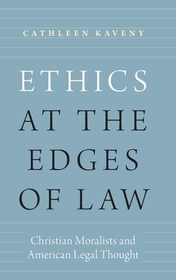
Ethics at the Edges of Law
Christian Moralists and American Legal Thought
- Publisher's listprice GBP 35.99
-
16 249 Ft (15 475 Ft + 5% VAT)
The price is estimated because at the time of ordering we do not know what conversion rates will apply to HUF / product currency when the book arrives. In case HUF is weaker, the price increases slightly, in case HUF is stronger, the price goes lower slightly.
- Discount 10% (cc. 1 625 Ft off)
- Discounted price 14 624 Ft (13 928 Ft + 5% VAT)
Subcribe now and take benefit of a favourable price.
Subscribe
16 249 Ft

Availability
printed on demand
Why don't you give exact delivery time?
Delivery time is estimated on our previous experiences. We give estimations only, because we order from outside Hungary, and the delivery time mainly depends on how quickly the publisher supplies the book. Faster or slower deliveries both happen, but we do our best to supply as quickly as possible.
Product details:
- Publisher OUP USA
- Date of Publication 16 November 2017
- ISBN 9780190612290
- Binding Hardback
- No. of pages328 pages
- Size 239x157x33 mm
- Weight 567 g
- Language English 0
Categories
Short description:
In Ethics at the Edges of Law, Cathleen Kaveny argues that religious moralists should treat the law as a valuable conversation partner, rather than a mere instrument for enforcing judgments about morality and public policy. Using cases and concepts from tort law, contract law, and criminal law, Kaveny shows how they can be used to illuminate the work of some of the most important contemporary Christian ethicists.
MoreLong description:
Ethics at the Edges of Law makes the case that religious moralists should treat the discipline of law as a valuable conversation partner, rather than reducing it to a vehicle for enforcing judgments about morality and public policy. Religious moralists should treat the secular law as a source of moral wisdom and conceptual insight, in the same way that they treat the discipline of philosophy. Cathleen Kaveny develops her argument by showing how the work of a range of important contemporary figures in Christian ethics, including John Noonan, Stanley Hauerwas, and Margaret Farley, can be enriched and illuminated by engagement with particular aspects of the American legal tradition. The book is divided into three parts: Part I, "Narratives and Norms," examines how the workings of the legal tradition can shed light on the development of religious and moral traditions. Part II, "Love, Justice, and Law," uses particular legal cases and controversies to advance questions about the relationship of love and justice in Christian ethics. Part III, "Legal Categories and Theological Problems," shows how legal categories and concepts can help reframe and even resolve particular moral controversies within religious communities. Ethics at the Edges of Law jumpstarts a fruitful, mutually engaged conversation between the American legal tradition and the tradition of Christian ethics.
In the end, while Kaveny's book and its conceptually rich mining of the disciplines of law and religious ethics is directed, in the first instance, toward the revitalization of the field of religious ethics, Kaveny's many reflections on legal pedagogy suggest that interdisciplinary approaches can benefit the study of law, as well.
Table of Contents:
Dedication
Preface
Introduction
Part I Narratives and Norms
Chapter 1 Tradition and Development
- Engaging John T. Noonan, Jr.
Chapter 2 Creation and Covenant
- Engaging Stanley Hauerwas
Chapter 3 Examples and Rules
-Engaging Jeffrey Stout
Part II Love, Justice, and Law
Chapter 4 Neighbor Love and Legal Precedent
- Engaging Gene Outka
Chapter 5 Compassionate Respect and Victims' Voices
- Engaging Margaret Farley
Chapter 6 Covenant Fidelity and Culture Wars
- Engaging Paul Ramsey
Part III Legal Categories and Theological Problems
Chapter 7 Juridical Insights and Theological Disputes
- Engaging Robert E. Rodes, Jr.
Chapter 8 Second Chances and Statutes of Limitations
- Engaging Walter Kasper
Chapter 9 Legalism and Christian Ethics
- Engaging Grisez and Engelhardt
Conclusion

