

- Publisher's listprice GBP 107.50
-
51 358 Ft (48 912 Ft + 5% VAT)
The price is estimated because at the time of ordering we do not know what conversion rates will apply to HUF / product currency when the book arrives. In case HUF is weaker, the price increases slightly, in case HUF is stronger, the price goes lower slightly.
- Discount 10% (cc. 5 136 Ft off)
- Discounted price 46 222 Ft (44 021 Ft + 5% VAT)
Subcribe now and take benefit of a favourable price.
Subscribe
51 358 Ft

Availability
printed on demand
Why don't you give exact delivery time?
Delivery time is estimated on our previous experiences. We give estimations only, because we order from outside Hungary, and the delivery time mainly depends on how quickly the publisher supplies the book. Faster or slower deliveries both happen, but we do our best to supply as quickly as possible.
Product details:
- Publisher OUP Oxford
- Date of Publication 18 November 1999
- ISBN 9780198233886
- Binding Hardback
- No. of pages206 pages
- Size 242x161x16 mm
- Weight 475 g
- Language English
- Illustrations 6 halftones, line figures 0
Categories
Short description:
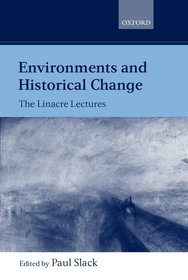
This book explores the shifting relationship between people and their environment by focusing on the relationship between the environmental and historical change. It examines questions such as; how has climate fluctuated and why? how have people exploited natural and defined their local place in it?; and why have boundaries taken the shapes they have?
MoreLong description:
Present anxieties about global warming and threats to biodiversity leave no doubts that environmental changes impact upon humans. Perceptions of the environment change as people try to define and shape 'nature' in different ways. The book explores the relationship between environmental change and society from the last Ice Age to the present. The book examines the environmental impact of fluctuations in climate and the demand for energy, and the patters which human societies have imposed on their surroundings, from boundaries to the cultural projections of legends and film. Together they show how insights from the disciplines of geography and geography, history and anthropology, can throw fresh light on the long-term attachment of people to place.
The chapters in this book were originally delivered as Linacre Lectures at Linacre College, Oxford University
All of the contributions present interesting views of environmental issues with a temporal dimension, and make for stimulating reading

