

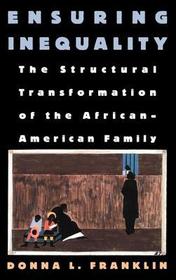
Ensuring Inequality
The Structural Transformation of the African-American Family
- Publisher's listprice GBP 35.49
-
16 955 Ft (16 147 Ft + 5% VAT)
The price is estimated because at the time of ordering we do not know what conversion rates will apply to HUF / product currency when the book arrives. In case HUF is weaker, the price increases slightly, in case HUF is stronger, the price goes lower slightly.
- Discount 10% (cc. 1 696 Ft off)
- Discounted price 15 259 Ft (14 532 Ft + 5% VAT)
Subcribe now and take benefit of a favourable price.
Subscribe
16 955 Ft

Availability
printed on demand
Why don't you give exact delivery time?
Delivery time is estimated on our previous experiences. We give estimations only, because we order from outside Hungary, and the delivery time mainly depends on how quickly the publisher supplies the book. Faster or slower deliveries both happen, but we do our best to supply as quickly as possible.
Product details:
- Publisher OUP USA
- Date of Publication 26 June 1997
- ISBN 9780195100785
- Binding Hardback
- No. of pages288 pages
- Size 242x163x26 mm
- Weight 549 g
- Language English
- Illustrations line figures, 1 table 0
Categories
Short description:
This book analyses the evolution of the contemporary African American family from historical cultural and social policy perspectives in an effort to understand why marital ties have weakened among poor African Americans and why mother-only families have increasingly become a normal feature of ghetto poverty. Franklin argues that the cumulative effects of slavery, sharecropping, and urbanization significantly weakened African American family ties and that mother-only families emerged in the early 20th century as a response to the instability of wage labour for African Americans.
MoreLong description:
This book analyses the evolution of the contemporary African American family from historical cultural and social policy perspectives in an effort to understand why marital ties have weakened among poor African Americans and why mother-only families have increasingly become a normal feature of ghetto poverty. Franklin argues that the cumulative effects of slavery, sharecropping, and urbanization significantly weakened African American family ties and that mother-only families emerged in the early 20th century as a response to the instability of wage labour for African Americans.
Donna Franklin's book is an excellent illustration of the importance of history to the understanding of current problems. She provides the reader with a very important lesson in how to understand current stresses in family life by studying the ways in which early experiences and circumstances led logically and inevitably to the present depressing, even alarming, state of family life at the end of the twentieth century. This is an important work.

