

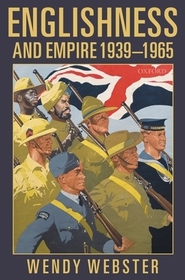
Englishness and Empire 1939-1965
- Publisher's listprice GBP 137.50
-
65 690 Ft (62 562 Ft + 5% VAT)
The price is estimated because at the time of ordering we do not know what conversion rates will apply to HUF / product currency when the book arrives. In case HUF is weaker, the price increases slightly, in case HUF is stronger, the price goes lower slightly.
- Discount 10% (cc. 6 569 Ft off)
- Discounted price 59 121 Ft (56 306 Ft + 5% VAT)
Subcribe now and take benefit of a favourable price.
Subscribe
65 690 Ft

Availability
printed on demand
Why don't you give exact delivery time?
Delivery time is estimated on our previous experiences. We give estimations only, because we order from outside Hungary, and the delivery time mainly depends on how quickly the publisher supplies the book. Faster or slower deliveries both happen, but we do our best to supply as quickly as possible.
Product details:
- Publisher OUP Oxford
- Date of Publication 3 March 2005
- ISBN 9780199258604
- Binding Hardback
- No. of pages264 pages
- Size 242x163x19 mm
- Weight 543 g
- Language English 0
Categories
Short description:
Did loss of imperial power and the end of empire have any significant impact on metropolitan culture and identity after 1939? Within a burgeoning literature on national identity and Englishness, this is a question that has received surprisingly little attention.
Drawing on extensive research in the media archive, Englishness and Empire explores how far, and in what contexts and unexpected places, imperial identity and loss of imperial power resonated in popular narratives of nation. As the first full monograph to investigate the significance of empire and its legacies in shaping national identity after 1939, this is an important study for scholars and students of modern British history, empire and Commonwealth, decolonisation, migration, gender, ethnicity, and race.
Long description:
Did loss of imperial power and the end of empire have any significant impact on metropolitan culture and identity after 1939? Within a burgeoning literature on national identity and Englishness, this is a question that has received surprisingly little attention.
Drawing on extensive research in the media archive, Wendy Webster's highly readable study investigates popular narratives of nation, and the significance of empire and its legacies in shaping national identity after 1939. What were the tensions and uncertainties involved in defining a post-imperial nation? How did imperial legacies inform questions about who belonged in Britain and debates about race, immigration and nationality? What did the Commonwealth mean? What was the significance of America to the making of a post-imperial nation? Focusing on stories told through prolific filmic and television imagery - the Second World War, the Coronation and Everest, colonial wars of the 1950s, Winston Churchill's funeral - the book explores how far, and in what contexts and unexpected places, imperial identity and loss of imperial power resonated in popular narratives of nation.
A novel thematic focus on empire and Englishness in the post-1945 period makes this an important study for scholars and students of modern British history, empire and Commonwealth, decolonisation, migration, gender, ethnicity, and race.
...an impressive book, valuable for its exhaustive and multifaceted use of sources and for the author's sophisticated perceptions of cultural change and its impact.
Table of Contents:
Introduction
The People's Empire and the People's War
The Post-War People's Empire
Coronation Britain
Colonial Wars
Immigration
Elegies for Empire: The Romance of Manliness
Epilogue
Bibliography

