

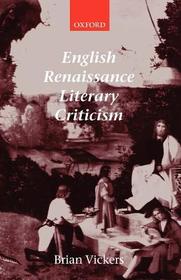
English Renaissance Literary Criticism
- Publisher's listprice GBP 105.00
-
47 407 Ft (45 150 Ft + 5% VAT)
The price is estimated because at the time of ordering we do not know what conversion rates will apply to HUF / product currency when the book arrives. In case HUF is weaker, the price increases slightly, in case HUF is stronger, the price goes lower slightly.
- Discount 10% (cc. 4 741 Ft off)
- Discounted price 42 667 Ft (40 635 Ft + 5% VAT)
Subcribe now and take benefit of a favourable price.
Subscribe
47 407 Ft

Availability
printed on demand
Why don't you give exact delivery time?
Delivery time is estimated on our previous experiences. We give estimations only, because we order from outside Hungary, and the delivery time mainly depends on how quickly the publisher supplies the book. Faster or slower deliveries both happen, but we do our best to supply as quickly as possible.
Product details:
- Publisher OUP Oxford
- Date of Publication 20 February 2003
- ISBN 9780199261369
- Binding Paperback
- No. of pages672 pages
- Size 216x202x34 mm
- Weight 782 g
- Language English
- Illustrations 1 halftone 0
Categories
Short description:
This is the first comprehensive collection of English Renaissance literary criticism to appear for nearly a century. In his wide-ranging introduction Vickers demonstrates that English critics in the period 1520 to 1650 owed most to classical writers on rhetoric and poetics: Cicero, Horace, Quintilian, Plutarch. All selections are annotated, identifying classical and other sources, and giving translations for Greek, Latin, and Italian texts. A section is devoted to Further Reading, and an extensive glossary is provided for archaic and technical words.
MoreLong description:
This is the first comprehensive collection of English Renaissance literary criticism to appear for nearly a century. Brian Vickers has brought together a wide-ranging selection of texts, some well-known (such as Sir Philip Sidney's Apology for Poetry, the most brilliant critical essay of the whole Renaissance, here given complete), some little-known (Dudley North's account of Metaphysical poetry), and one being printed for the first time (John Ford's elegy on John Fletcher).
In an extensive introduction the editor surveys the main sources and models for English criticism, which turn out to be the major classical texts fusing poetics and rhetoric: Cicero, Quintilian, Horace, Plutarch. Whereas modern literary theory conceives of an autonomous poetic (the poem existing as a verbal artefact, irrespective of its influence on the reader) in the Renaissance all critical theories were rhetorical, seeing literature as having a deliberate design on its readers, to arouse their feelings and to make them love virtue, hate vice. Writers commonly saw their task as being to 'inflame' readers with the desire to emulate goodness.
Renaissance literary criticism is also prescriptive, not descriptive: that is, it describes how literature should be written and what effects it should strive for. Accepting this orientation, the editor has included a substantial selection from the major hand-books on rhetoric and poetics, Thomas Wilson's The Arte of Rhetorique (1560) and George Puttenham's The Arte of English Poesie (1589). The emphasis throughout is on the links between literary criticism and literature itself. Most of the selections were produced by the practitioners themselves, poets and dramatists discussing their art: Gascoigne, Spenser, Campion, Daniel, Jonson, Shakespeare (in one of the scenes he contributed to Edward III), Chapman, Fletcher, Heywood, Massinger, Milton. The anthology also includes discussions of all the major literary genres: Senecan tragedy, comedy, tragicomedy, pastoral and allegory, Homeric translations, epic and romance, religious and lyric poetry.
All selections are annotated, identifying classical and other sources, and giving translations for Greek, Latin, and Italian texts. A section is devoted to Further Reading, and an extensive glossary is provided for archaic and technical words.
Review from previous edition English Renaissance Literary Criticism may well become the standard reference collection ... the greatest coup is John Ford's elegy on John Fletcher, discovered by the late Jeremy Maule and printed here for the first time.
Table of Contents:
Preface
Abbreviations
Introduction
Further Reading
A Note on the Texts
Sir Thomas Elyot
Henry Howard
Thomas Wilson
Alexander Neville
William Baldwin
Roger Ascham
George Gascoigne
George Whetstone
Edmund Spenser and E.K.
George Puttenham
Edmund Spenser
Sir John Harrington
William Shakespeare
Gabriel Harvey
Sir Philip Sidney
George Chapman
Robert Southwell
John Hoskyns
Thomas Campion
Samuel Daniel
Ben Jonson, Rhymes against rhyme
Francis Bacon
Ben Jonson, The moral function of poetry
Thomas Heywood
John Fletcher
Dudley North
George Chapman
Ben Jonson, The faults of contemporary drama
William Drummond
Ben Jonson, A tribute to Shakespeare
John Ford
Philip Massinger
Thomas Carew
Ben Jonson, Notes on literature
John Milton
Thomas Hobbes
Glossary
List of Rhetorical Figures
Index

