

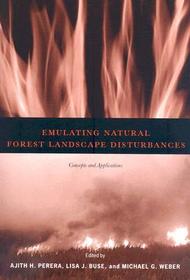
Emulating Natural Forest Landscape Disturbances
Concepts and Applications
- Publisher's listprice GBP 42.00
-
18 963 Ft (18 060 Ft + 5% VAT)
The price is estimated because at the time of ordering we do not know what conversion rates will apply to HUF / product currency when the book arrives. In case HUF is weaker, the price increases slightly, in case HUF is stronger, the price goes lower slightly.
- Discount 10% (cc. 1 896 Ft off)
- Discounted price 17 067 Ft (16 254 Ft + 5% VAT)
Subcribe now and take benefit of a favourable price.
Subscribe
18 963 Ft

Availability
Estimated delivery time: In stock at the publisher, but not at Prospero's office. Delivery time approx. 3-5 weeks.
Not in stock at Prospero.
Why don't you give exact delivery time?
Delivery time is estimated on our previous experiences. We give estimations only, because we order from outside Hungary, and the delivery time mainly depends on how quickly the publisher supplies the book. Faster or slower deliveries both happen, but we do our best to supply as quickly as possible.
Product details:
- Publisher Columbia University Press
- Date of Publication 8 February 2008
- ISBN 9780231129176
- Binding Paperback
- No. of pages352 pages
- Size 249x173 mm
- Language English 0
Categories
Short description:
This comprehensive collection of provocative papers provides a scientific foundation for justifying the use of and a solid framework for examining the ambiguities inherent in emulating natural forest landscape disturbance. Contributors range from policymakers and forestry professionals to academics and conservationists, offering a balanced view of the promises and challenges of the forest management paradigm in sustaining forest landscapes.
The book opens with an overview of foundational concepts, a detailed discussion of emerging forest management paradigms and their global context, and an examination of the ecological premise for emulating natural disturbance. This section also explores the current understanding of natural disturbance regimes, including the two most prevalent in North America: fire and insects. The volume then uses several geographically diverse case studies to address the characterization of natural disturbances and the development of applied templates for their emulation through forest management. The emphasis on fire regimes reflects the greater focus that has traditionally been placed on understanding and managing fire, compared with other forms of disturbance, and utilizes several viewpoints to address the lessons learned from historical disturbance patterns. Reflecting current developments in the field, immediate challenges, and potential directions, this collection concludes with a penetrating look at practical applications, exploring the expectations for and feasibility of emulating natural disturbance through forest management.
MoreLong description:
This comprehensive collection of provocative papers provides a scientific foundation for justifying the use of and a solid framework for examining the ambiguities inherent in emulating natural forest landscape disturbance. Contributors range from policymakers and forestry professionals to academics and conservationists, offering a balanced view of the promises and challenges of the forest management paradigm in sustaining forest landscapes.
The book opens with an overview of foundational concepts, a detailed discussion of emerging forest management paradigms and their global context, and an examination of the ecological premise for emulating natural disturbance. This section also explores the current understanding of natural disturbance regimes, including the two most prevalent in North America: fire and insects. The volume then uses several geographically diverse case studies to address the characterization of natural disturbances and the development of applied templates for their emulation through forest management. The emphasis on fire regimes reflects the greater focus that has traditionally been placed on understanding and managing fire, compared with other forms of disturbance, and utilizes several viewpoints to address the lessons learned from historical disturbance patterns. Reflecting current developments in the field, immediate challenges, and potential directions, this collection concludes with a penetrating look at practical applications, exploring the expectations for and feasibility of emulating natural disturbance through forest management.
More
