

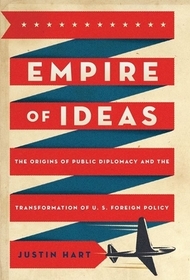
Empire of Ideas
The Origins of Public Diplomacy and the Transformation of U. S. Foreign Policy
- Publisher's listprice GBP 25.49
-
11 508 Ft (10 960 Ft + 5% VAT)
The price is estimated because at the time of ordering we do not know what conversion rates will apply to HUF / product currency when the book arrives. In case HUF is weaker, the price increases slightly, in case HUF is stronger, the price goes lower slightly.
- Discount 10% (cc. 1 151 Ft off)
- Discounted price 10 357 Ft (9 864 Ft + 5% VAT)
Subcribe now and take benefit of a favourable price.
Subscribe
11 508 Ft

Availability
printed on demand
Why don't you give exact delivery time?
Delivery time is estimated on our previous experiences. We give estimations only, because we order from outside Hungary, and the delivery time mainly depends on how quickly the publisher supplies the book. Faster or slower deliveries both happen, but we do our best to supply as quickly as possible.
Product details:
- Publisher OUP USA
- Date of Publication 21 July 2020
- ISBN 9780197532928
- Binding Paperback
- No. of pages296 pages
- Size 231x155x20 mm
- Weight 590 g
- Language English 22
Categories
Short description:
Empire of Ideas examines the origins of the U. S. government's programs in public diplomacy and how the nation's image in the world became an essential component of U. S. foreign policy.
MoreLong description:
Covering the period from 1936 to 1953, Empire of Ideas reveals how and why image first became a component of foreign policy, prompting policymakers to embrace such techniques as propaganda, educational exchanges, cultural exhibits, overseas libraries, and domestic public relations.
Drawing upon exhaustive research in official government records and the private papers of top officials in the Roosevelt and Truman administrations, including newly declassified material, Justin Hart takes the reader back to the dawn of what Time-Life publisher Henry Luce would famously call the "American century," when U.S. policymakers first began to think of the nation's image as a foreign policy issue. Beginning with the Buenos Aires Conference in 1936--which grew out of FDR's Good Neighbor Policy toward Latin America--Hart traces the dramatic growth of public diplomacy in the war years and beyond. The book describes how the State Department established the position of Assistant Secretary of State for Public and Cultural Affairs in 1944, with Archibald MacLeish--the Pulitzer Prize-winning poet and Librarian of Congress--the first to fill the post. Hart shows that the ideas of MacLeish became central to the evolution of public diplomacy, and his influence would be felt long after his tenure in government service ended. The book examines a wide variety of propaganda programs, including the Voice of America, and concludes with the creation of the United States Information Agency in 1953, bringing an end to the first phase of U. S. public diplomacy.
Empire of Ideas remains highly relevant today, when U. S. officials have launched full-scale propaganda to combat negative perceptions in the Arab world and elsewhere. Hart's study illuminates the similar efforts of a previous generation of policymakers, explaining why our ability to shape our image is, in the end, quite limited.
Hart is one of the new generation of historians beginning to shift scholarly discussion of empire away from polemics and lurid accounts of black operations. Public diplomacy comprised that crucial nexus between image management-so vital to the essential ideological work of all empire-and the private cultural sphere from which this democratic empire sprang.
Table of Contents:
Introduction: The Origins of U.S. Public Diplomacy
1. "Down with Imperialism": The Latin American Origins of U.S. Cultural Diplomacy
2. "The Drift of History": War, Culture, and Hegemony
3. Propaganda as Foreign Policy: The Office of War Information
4. "Foreign Relations, Domestic Affairs": The Consolidation of U.S. Public Diplomacy
5. "The Flat White Light": Revolutionary Nationalism in Asia and Beyond
6. "An Unfavorable Projection of American Unity": McCarthyism and Public Diplomacy
Epilogue The Creation of the USIA and the Fate of U.S. Public Diplomacy
Notes
Bibliography
Index

