

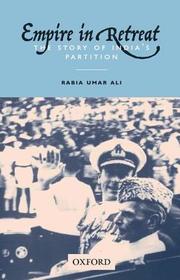
Empire in Retreat:
The Story of India's Partition
- Publisher's listprice GBP 15.99
-
7 219 Ft (6 875 Ft + 5% VAT)
The price is estimated because at the time of ordering we do not know what conversion rates will apply to HUF / product currency when the book arrives. In case HUF is weaker, the price increases slightly, in case HUF is stronger, the price goes lower slightly.
- Discount 10% (cc. 722 Ft off)
- Discounted price 6 497 Ft (6 188 Ft + 5% VAT)
Subcribe now and take benefit of a favourable price.
Subscribe
7 219 Ft

Availability
Out of print
Why don't you give exact delivery time?
Delivery time is estimated on our previous experiences. We give estimations only, because we order from outside Hungary, and the delivery time mainly depends on how quickly the publisher supplies the book. Faster or slower deliveries both happen, but we do our best to supply as quickly as possible.
Product details:
- Publisher OUP Pakistan
- Date of Publication 19 July 2012
- ISBN 9780199066087
- Binding Hardback
- No. of pages202 pages
- Size 224x147x17 mm
- Weight 396 g
- Language English 0
Categories
Long description:
The Indian subcontinent of 1947 became the necropolis of the British Raj. The struggle for freedom and independence had finally culminated in the creation of two new and sovereign states, India and Pakistan. The dawn of liberty, however, brought in its wake a human tragedy of colossal magnitude of which contemporary history has no parallels. The violence, mass migrations, rape, arson and killings that accompanied partition, all spoke of the stupendous price that was paid by millions to drive
the British out and attain the choice of self rule.
The hasty British departure pre-empted the partition of India that made a farce of planning for one of the most significant developments of the twentieth century. It was by no means given the priority and attention that an event of such enormity deserved. Moreover, the imperial inclination towards the Indian National Congress in all matters of planning, consultation, decision making and implementation do not speak of a fair and neutral arbitration of Indian destiny. The 'swing speed' with
which the plan was put together, the unbridled haste with which the day of freedom was announced, the unpardonable rush in which a land of millions was dissected, the hurried retreat that betrayed a dying Raj and the un-judicious distribution of the goods, resources and assets of the subcontinent all
quantified to a huge disaster.
The result of such a planning was carnage and disruption and a complete breakdown of law and order. The gloom and sorrow that saw the dawn of independence could not destroy the will and hope of the nations freed from long bondage, yet it helped little in embarking upon an auspicious new journey of sovereign existence. The inherently flawed plan, both in making and content, that was so proudly carved out by the 'best surgeons of India' unfortunately carried in it seeds of a protracted conflict
and violent friction. The legacy of mutual hate and distrust thus initiated between the two states became an agent for carrying the burden of a forced baggage that has made the peace and prosperity of the region a lost dream. And the blame rests mainly on the departing authorities for which there is
possibly no redemption.
Table of Contents:
Acknowledgements
Introduction
British Approach to Partition: The Reluctant Concession
Evolution of the Partition Plan: The Hurried Scuttle
The Radcliffe Award and its Dictates: The Scalpel at Work
Implementation: The Final Pandemonium
Conclusion
Appendices
Bibliography
Index

