

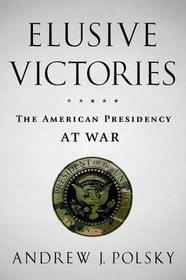
Elusive Victories
The American Presidency at War
- Publisher's listprice GBP 26.49
-
11 960 Ft (11 390 Ft + 5% VAT)
The price is estimated because at the time of ordering we do not know what conversion rates will apply to HUF / product currency when the book arrives. In case HUF is weaker, the price increases slightly, in case HUF is stronger, the price goes lower slightly.
- Discount 10% (cc. 1 196 Ft off)
- Discounted price 10 764 Ft (10 251 Ft + 5% VAT)
Subcribe now and take benefit of a favourable price.
Subscribe
11 960 Ft

Availability
printed on demand
Why don't you give exact delivery time?
Delivery time is estimated on our previous experiences. We give estimations only, because we order from outside Hungary, and the delivery time mainly depends on how quickly the publisher supplies the book. Faster or slower deliveries both happen, but we do our best to supply as quickly as possible.
Product details:
- Publisher OUP USA
- Date of Publication 14 June 2012
- ISBN 9780199860937
- Binding Hardback
- No. of pages456 pages
- Size 236x165x38 mm
- Weight 748 g
- Language English 0
Categories
Short description:
A penetrating analysis of the multiple dimensions of presidential leadership in wartime
MoreLong description:
On April 4, 1864, Abraham Lincoln made a shocking admission about his presidency during the Civil War. "I claim not to have controlled events," he wrote in a letter, "but confess plainly that events have controlled me." Lincoln's words carry an invaluable lesson for wartime presidents, writes Andrew J. Polsky in this seminal book. As Polsky shows, when commanders-in-chief do try to control wartime events, more often than not they fail utterly.
In Elusive Victories, Polsky provides a fascinating study of six wartime presidents, drawing larger lessons about the limits of the power of the White House during armed conflict. He examines, in turn, Lincoln, Woodrow Wilson, Franklin D. Roosevelt, Lyndon Johnson, Richard Nixon, George W. Bush, and Barack Obama, showing how each gravely overestimated his power as commander-in-chief. In each case, these presidents' resources did not match the key challenges that recur from war to war. Both Lincoln and Johnson intervened in military operations, giving orders to specific units; yet both struggled with the rising unpopularity of their conflicts. Both Wilson and Bush entered hostilities with idealistic agendas for the aftermath, yet found themselves helpless to enact them. With insight and clarity, Polsky identifies overarching issues that will inform current and future policymakers. The single most important dynamic, he writes, is the erosion of a president's freedom of action. Each decision propels him down a path from which he cannot turn back. When George W. Bush rejected the idea of invading Iraq with 400,000 troops, he could not send such a force two years later as the insurgency spread. In the final chapter, Polsky examines Barack Obama's options in light of these conclusions, and considers how the experiences of the past might inform the world we face now.
Elusive Victories is the first book to provide a comprehensive account of presidential leadership during wartime, highlighting the key dangers that presidents have ignored at their peril.
Table of Contents:
Chapter 1 Introduction
Chapter 2 The Ideal Wartime Leader: Lincoln Casts a Shadow
Chapter 3 A War to Transform the World: Wilson Misjudges His Powers
Chapter 4 Freedom of Action: Franklin Roosevelt Resists Hard Choices
Chapter 5 Staying the Course: Johnson and Nixon Pay the Political Costs of Military Stalemate
Chapter 6 The Perils of Optimism: George W. Bush with Forseeable Disaster
Chapter 7 Conclusion: Lessons for Obama's War and Beyond

