

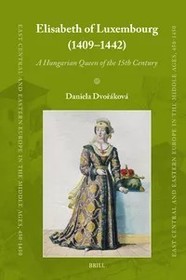
Elisabeth of Luxembourg (1409–1442)
A Hungarian Queen of the 15th Century
Series: East Central and Eastern Europe in the Middle Ages, 450-1450; 96;
- Publisher's listprice EUR 158.00
-
61 714 Ft (58 776 Ft + 5% VAT)
The price is estimated because at the time of ordering we do not know what conversion rates will apply to HUF / product currency when the book arrives. In case HUF is weaker, the price increases slightly, in case HUF is stronger, the price goes lower slightly.
- Discount 5% (cc. 3 085 Ft off)
- Discounted price 58 629 Ft (55 837 Ft + 5% VAT)
Subcribe now and take benefit of a favourable price.
Subscribe
61 714 Ft

Availability
printed on demand
Why don't you give exact delivery time?
Delivery time is estimated on our previous experiences. We give estimations only, because we order from outside Hungary, and the delivery time mainly depends on how quickly the publisher supplies the book. Faster or slower deliveries both happen, but we do our best to supply as quickly as possible.
Product details:
- Edition number 1
- Publisher Brill
- Date of Publication 20 February 2025
- ISBN 9789004722545
- Binding Hardback
- No. of pages244 pages
- Size 235x155x21 mm
- Weight 544 g
- Language English 916
Categories
Long description:
This book is dedicated to an exceptional and almost forgotten figure of European medieval history, Queen Elisabeth of Luxembourg. Through the story of her life, the author of this volume examines one of the most dramatic periods of Hungarian medieval history (1437–1442), when after the death of Emperor Sigismund of Luxembourg, the kingdom lacked a strong monarch.
Although the primary focus of this book is Queen Elisabeth, much attention is also paid to her husband, the Duke of Austria and the Roman-German King Albert II of Habsburg. The author reconstructs his short reign in the Kingdom of Hungary on the basis of hitherto unpublished sources, as well as Queen Elisabeth’s struggle for the Hungarian crown, which she finally won at the cost of her own life. Through the inclusion of discussions on topics such as the status of women, hygiene, medicine, piety, and travel, the author sheds light not just on the details of Elisabeth’s life, but also on life during this period of medieval history more generally.

