
• Contact

  • Newsletter

  • About us

  • Delivery options

  • Prospero Book Market Podcast

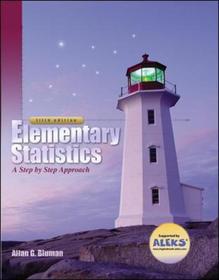
  • Elementary Statistics: A Step-By-Step Approach with MathZone Student Edition

    Elementary Statistics: A Step-By-Step Approach with MathZone Student Edition by Bluman, Allan G.;

      • GET 10% OFF

      • The discount is only available for 'Alert of Favourite Topics' newsletter recipients.
      • Publisher's listprice GBP 85.61
      • The price is estimated because at the time of ordering we do not know what conversion rates will apply to HUF / product currency when the book arrives. In case HUF is weaker, the price increases slightly, in case HUF is stronger, the price goes lower slightly.

        40 900 Ft (38 952 Ft + 5% VAT)
      • Discount 10% (cc. 4 090 Ft off)
      • Discounted price 36 810 Ft (35 057 Ft + 5% VAT)

    40 900 Ft

    Availability

    Uncertain availability. Please turn to our customer service.

    Why don't you give exact delivery time?

    Delivery time is estimated on our previous experiences. We give estimations only, because we order from outside Hungary, and the delivery time mainly depends on how quickly the publisher supplies the book. Faster or slower deliveries both happen, but we do our best to supply as quickly as possible.

    Product details:

    • Edition number 5
    • Publisher McGraw-Hill Higher Education
    • Date of Publication 1 July 2003

    • ISBN 9780073016474
    • Binding Unidentified
    • No. of pages0 pages
    • Size 289x213x34 mm
    • Weight 1810 g
    • Language English
    • 0

    Categories

    Long description:

    ELEMENTARY STATISTICS: A STEP BY STEP APPROACH is for general beginning statistics courses with a basic algebra prerequisite. The book is non-theoretical, explaining concepts intuitively and teaching problem solving through worked examples and step-by-step instructions. This edition features increased emphasis on Excel, MINITAB, and the TI-83 Plus graphing calculator, computing technologies commonly used in such coureses.

    ELEMENTARY STATISTICS: A STEP BY STEP APPROACH is for general beginning statistics courses with a basic algebra prerequisite. The book is non-theoretical, explaining concepts intuitively and teaching problem solving through worked examples and step-by-step instructions. This edition features increased emphasis on Excel, MINITAB, and the TI-83 Plus graphing calculator, computing technologies commonly used in such coureses.

    More

    Table of Contents:

    1The Nature of Probability and Statistics

    1-1 Introduction

    1-2 Descriptive and Inferential Statistics

    1-3 Variables and Types of Data

    1-4 Data Collection and Sampling Techniques

    1-5 Observational and Experimental Studies

    1-6 Uses and Misuses of Statistics

    1-7 Computers and Calculators

    1-8 Summary

    2Frequency Distributions and Graphs

    2-1 Introduction

    2-2 Organizing Data

    2-3 Histograms, Frequency Polygons, and Ogives

    2-4 Other Types of Graphs

    2-5 Summary

    3Data Description

    3-1 Introduction

    3-2 Measures of Central Tendency

    3-3 Measures of Variation

    3-4 Measures of Position

    3-5 Exploratory Data Analysis

    3-6 Summary

    4Probability and Counting Rules

    4-1 Introduction

    4-2 Sample Spaces and Probability

    4-3 The Addition Rules for Probability

    4-4 The Multiplication Rules and Conditional Probability

    4-5 Counting Rules

    4-6 Probability and Counting Rules

    4-7 Summary

    5Discrete Probability Distributions

    5-1 Introduction

    5-2 Probability Distributions

    5-3 Mean, Variance, and Expectation

    5-4 The Binomial Distribution

    5-5 Other Types of Distributions (Optional)

    5-6 Summary

    6The Normal Distribution

    6-1 Introduction

    6-2 Properties of the Normal Distribution

    6-3 The Standard Normal Distribution

    6-4 Applications of the Normal Distribution

    6-5 The Central Limit Theorem

    6-6 The Normal Approximation to the Binomial Distribution

    6-7 Summary

    7 Confidence Intervals and Sample Size

    7-1 Introduction

    7-2 Confidence Intervals for the Mean (s Known or n30)

    7-3 Confidence Intervals for the Mean (s Unknown or n<30)

    7-4 Confidence Intervals and Sample Size for Proportions

    7-5 Confidence Intervals for Variances and Standard Deviations

    7-6 Summary

    8Hypothesis Testing

    8-1 Introduction

    8-2 Steps in Hypothesis Testing - Traditional Method

    8-3 z Test for a Mean

    8-4 t Test for a Mean

    8-5 z Test for a Proportion

    8-6 chi^2 test for a Variance or Standard Deviation

    8-7 Additional Topics Regarding Hypothesis Testing

    8-8 Summary

    9Testing the Difference Between Two Means, Two Variances, and Two Proportions

    9-1 Introduction

    9-2 Testing the Difference Between Two Means: Large Samples

    9-3 Testing the Difference Between Two Variances

    9-4 Testing the Difference Between Two Means: Small Independent Samples

    9-5 Testing the Difference Between Two Means: Small Dependent Samples

    9-6 Testing the Difference Between Proportions

    9-7 Summary

    10Correlation and Regression

    10-1 Introduction

    10-2 Scatter Plots

    10-3 Correlation

    10-4 Regression

    10-5 Coefficient of Determination and Standard Error of the Estimate

    10-6 Multiple Regression (Optional)

    10-7 Summary

    11Other Chi-Square Tests

    11-1 Introduction

    11-2 Test for Goodness of Fit

    11-3 Tests Using Contingency Tables

    11-4 Summary

    12 Analysis of Variance

    12-1 Introduction

    12-2 One-Way Analysis of Variance

    12-3 The Scheffé Test and the Tukey Test

    12-4 Two-Way Analysis of Variance

    12-5 Summary

    13Nonparametric Statistics

    13-1 Introduction

    13-2 Advantages and Disadvantages of Nonparametric Methods

    13-3 The Sign Test

    13-4 The Wilcoxon Rank Sum Test

    13-5 The Wilcoxon Signed-Rank Test

    13-6 The Kruskal-Wallis Test

    13-7 The Spearman Rank Correlation Coefficient and the Runs Test

    18-8 Summary

    14Sampling and Simulation

    14-1 Introduction

    14-2 Common Sampling Techniques

    14-3 Surveys and Questionnaire Design

    14-4 Simulation Techniques

    14-5 The Monte Carlo Method

    14-6 Summary

    Appendix A: Algebra Review

    Appendix B-1: Writing the Research Report

    Appendix B-2: Bayes's Theorem

    Appendix B-3: Alternate Method for the Standard Normal Distribution

    Appendix C: Tables

    Appendix D: Data Bank

    Appendix E: Glossary

    Appendix F: Bibliography

    Appendix G: Photo Credits

    Appendix H: Selected Answers

    More

    0