

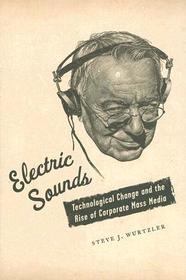
Electric Sounds
Technological Change and the Rise of Corporate Mass Media
Series: Film and Culture Series;
- Publisher's listprice GBP 117.00
-
55 896 Ft (53 235 Ft + 5% VAT)
The price is estimated because at the time of ordering we do not know what conversion rates will apply to HUF / product currency when the book arrives. In case HUF is weaker, the price increases slightly, in case HUF is stronger, the price goes lower slightly.
- Discount 10% (cc. 5 590 Ft off)
- Discounted price 50 307 Ft (47 912 Ft + 5% VAT)
Subcribe now and take benefit of a favourable price.
Subscribe
55 896 Ft

Availability
Temporarily out of stock.
Why don't you give exact delivery time?
Delivery time is estimated on our previous experiences. We give estimations only, because we order from outside Hungary, and the delivery time mainly depends on how quickly the publisher supplies the book. Faster or slower deliveries both happen, but we do our best to supply as quickly as possible.
Product details:
- Publisher Columbia University Press
- Date of Publication 23 February 2007
- ISBN 9780231136761
- Binding Hardback
- No. of pages416 pages
- Size 228x152 mm
- Language English 0
Categories
Short description:
The 1920s and 1930s marked some of the most important developments in the history of the American mass media: the film industry's conversion to synchronous sound, the rise of radio networks and advertising-supported broadcasting, the establishment of a federal regulatory framework, and the birth of a new acoustic commodity in which consumers accessed stories, songs, and other products through multiple media formats.
The innovations of this period not only restructured and consolidated corporate mass media interests while shifting the conventions of media consumption. They renegotiated the social functions assigned to mass media forms. In this impeccably researched history, Steve J. Wurtzler grasps the full story of sounds media, proving that the ultimate form technology takes is never predetermined but shaped by conflicting visions of technological possibility in economic, cultural, and political realms. --
MoreLong description:
The 1920s and 1930s marked some of the most important developments in the history of the American mass media: the film industry's conversion to synchronous sound, the rise of radio networks and advertising-supported broadcasting, the establishment of a federal regulatory framework, and the birth of a new acoustic commodity in which consumers accessed stories, songs, and other products through multiple media formats.
The innovations of this period not only restructured and consolidated corporate mass media interests while shifting the conventions of media consumption. They renegotiated the social functions assigned to mass media forms. In this impeccably researched history, Steve J. Wurtzler grasps the full story of sounds media, proving that the ultimate form technology takes is never predetermined but shaped by conflicting visions of technological possibility in economic, cultural, and political realms. --
More
