

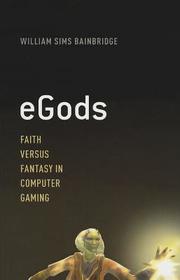
eGods
Faith versus Fantasy in Computer Gaming
- Publisher's listprice GBP 112.50
-
53 746 Ft (51 187 Ft + 5% VAT)
The price is estimated because at the time of ordering we do not know what conversion rates will apply to HUF / product currency when the book arrives. In case HUF is weaker, the price increases slightly, in case HUF is stronger, the price goes lower slightly.
- Discount 10% (cc. 5 375 Ft off)
- Discounted price 48 372 Ft (46 068 Ft + 5% VAT)
Subcribe now and take benefit of a favourable price.
Subscribe
53 746 Ft

Availability
printed on demand
Why don't you give exact delivery time?
Delivery time is estimated on our previous experiences. We give estimations only, because we order from outside Hungary, and the delivery time mainly depends on how quickly the publisher supplies the book. Faster or slower deliveries both happen, but we do our best to supply as quickly as possible.
Product details:
- Publisher OUP USA
- Date of Publication 4 April 2013
- ISBN 9780199935819
- Binding Hardback
- No. of pages336 pages
- Size 163x236x27 mm
- Weight 706 g
- Language English 0
Categories
Short description:
William Bainbridge contends that the worlds of massively multiplayer online roleplaying games provide a new perspective on the human quest, one that combines the arts and simulates most aspects of real life. The quests in gameworlds also provide meaning for human action, in terms of narratives about achieving goals by overcoming obstacles.
MoreLong description:
William Bainbridge takes an in-depth look at the fantasy religions that exist in 34 different massively multiplayer online roleplaying games. He categorizes the religions, noting similarities across the games. He points, for instance, to the prevalence of polytheism: a system which, Bainbridge argues, can function as an effective map of reality in which each deity personifies a concept. Religions are as much about conceptualizing the self as conceptualizing the sacred. Most games allow the players to have multiple avatars, an idea Bainbridge likens to contemporary scientific ideas about personality. He also focuses on sacred spaces; the prevalence of magic and its relationship to the computer program and programmer; the fostering of a tribal morality by both religion and rules programmed into the game; the rise of cults and belief systems within the game worlds (and how this relates to social science theories of cult formation in the real world); and, of course, how the gameworld religions depict death. As avatars are immortal, death is merely a minor setback in most games. At the same time, much of the action in some gameworlds centers on the issue of mortality and the problematic nature of resurrection.
Bainbridge contends that gameworlds are giving us a new perspective on the human quest, one that combines the arts and simulates most aspects of real life. The quests in gameworlds also provide meaning for human action, in terms of narratives about achieving goals by overcoming obstacles. Perhaps meaning does not naturally exist in our universe, but must be created by us, both in our fantasies and in day-to-day life. Like the games analyzed in this book, he says, traditional religions are fantasies that should be respected as works of art in a future civilization of disbelief.
eGods may serve as a helpful reference for those researching online gaming, religious symbols, or considering a literary analysis of gaming environments.
Table of Contents:
Chapter 1: Disbelief
Chapter 2: The Culture Game
Chapter 3: Deities
Chapter 4: Souls
Chapter 5: Priests
Chapter 6: Shrines
Chapter 7: Magic
Chapter 8: Morality
Chapter 9: Cults
Chapter 10: Death
Chapter 11: Quests
Appendix: The Gameworlds

