

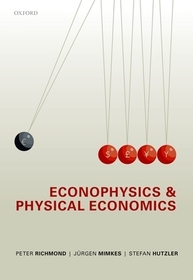
Econophysics and Physical Economics
- Publisher's listprice GBP 86.00
-
38 829 Ft (36 980 Ft + 5% VAT)
The price is estimated because at the time of ordering we do not know what conversion rates will apply to HUF / product currency when the book arrives. In case HUF is weaker, the price increases slightly, in case HUF is stronger, the price goes lower slightly.
- Discount 10% (cc. 3 883 Ft off)
- Discounted price 34 946 Ft (33 282 Ft + 5% VAT)
Subcribe now and take benefit of a favourable price.
Subscribe
38 829 Ft

Availability
Estimated delivery time: In stock at the publisher, but not at Prospero's office. Delivery time approx. 3-5 weeks.
Not in stock at Prospero.
Why don't you give exact delivery time?
Delivery time is estimated on our previous experiences. We give estimations only, because we order from outside Hungary, and the delivery time mainly depends on how quickly the publisher supplies the book. Faster or slower deliveries both happen, but we do our best to supply as quickly as possible.
Product details:
- Publisher OUP Oxford
- Date of Publication 5 September 2013
- ISBN 9780199674701
- Binding Hardback
- No. of pages258 pages
- Size 253x180x20 mm
- Weight 720 g
- Language English
- Illustrations 111 b/w illustrations 0
Categories
Short description:
This book summarises progress in the understanding of financial markets and economics based on the established methodology of statistical physics. It offers a new approach to the fundamentals of economics that offers the potential for increased insight and understanding. It should be of interest to all serious students of the subject.
MoreLong description:
An understanding of the behaviour of financial assets and the evolution of economies has never been as important as today. This book looks at these complex systems from the perspective of the physicist. So called 'econophysics' and its application to finance has made great strides in recent years. Less emphasis has been placed on the broader subject of macroeconomics and many economics students are still taught traditional neo-classical economics.
The reader is given a general primer in statistical physics, probability theory, and use of correlation functions. Much of the mathematics that is developed is frequently no longer included in undergraduate physics courses. The statistical physics of Boltzmann and Gibbs is one of the oldest disciplines within physics and it can be argued that it was first applied to ensembles of molecules as opposed to being applied to social agents only by way of historical accident. The authors argue by analogy that the theory can be applied directly to economic systems comprising assemblies of interacting agents. The necessary tools and mathematics are developed in a clear and concise manner. The body of work, now termed econophysics, is then developed. The authors show where traditional methods break down and show how the probability distributions and correlation functions can be properly understood using high frequency data. Recent work by the physics community on risk and market crashes are discussed together with new work on betting markets as well as studies of speculative peaks that occur in housing markets.
The second half of the book continues the empirical approach showing how by analogy with thermodynamics, a self-consistent attack can be made on macroeconomics. This leads naturally to economic production functions being equated to entropy functions - a new concept for economists. Issues relating to non-equilibrium naturally arise during the development and application of this approach to economics. These are discussed in the context of superstatistics and adiabatic processes. As a result it does seem ultimately possible to reconcile the approach with non-equilibrium systems, and the ideas are applied to study income and wealth distributions, which with their power law distribution functions have puzzled many researchers ever since Pareto discovered them over 100 years ago. This book takes a pedagogical approach to these topics and is aimed at final year undergraduate and beginning gradaute or post-graduate students in physics, economics, and business. However, the experienced researcher and quant should also find much of interest.
We argue that similarlaws apply to assemblies of interacting economic agents for which repeatable experiments are also not always possible. The theory leads naturally to an understanding of a range of financial and economic phenomena. One central issue, namely that of non-equilibrium, is also discussed by drawing on recent ideas developed to explore the phenomenon in physical systems, which leads to new insights into the distribution functions of the interacting agents. It is our view that this approach, which combines both theory and empiricism, offers scope for further development and application.
Table of Contents:
Introduction
Reading financial data
Basics of probability
Time dependent processes and the Chapman-Kolmogorov equation
The Langevin approach to modelling Brownian motion
The Brownian motion model of asset prices
Generalized diffusion processes and the Fokker-Planck equation
Derivatives and options
Asset fluctuations and scaling
Models of asset fluctuations
Risk
Why markets crash
Two non-financial markets
An introduction to physical economics
Laws of physical economics
Markets
A simple model of trade
Production and economic growth
Economics and entropy
Approaches to non-equilibrium economics
The distribution of wealth in society
Conclusions and outlook

