

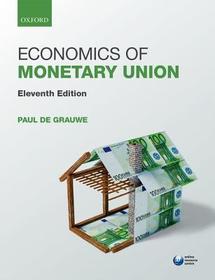
Economics of Monetary Union
- Publisher's listprice GBP 48.99
-
23 404 Ft (22 290 Ft + 5% VAT)
The price is estimated because at the time of ordering we do not know what conversion rates will apply to HUF / product currency when the book arrives. In case HUF is weaker, the price increases slightly, in case HUF is stronger, the price goes lower slightly.
- Discount 10% (cc. 2 340 Ft off)
- Discounted price 21 064 Ft (20 061 Ft + 5% VAT)
Subcribe now and take benefit of a favourable price.
Subscribe
23 404 Ft

Availability
Out of print
Why don't you give exact delivery time?
Delivery time is estimated on our previous experiences. We give estimations only, because we order from outside Hungary, and the delivery time mainly depends on how quickly the publisher supplies the book. Faster or slower deliveries both happen, but we do our best to supply as quickly as possible.
Product details:
- Edition number 11
- Publisher OUP Oxford
- Date of Publication 4 February 2016
- ISBN 9780198739876
- Binding Paperback
- No. of pages288 pages
- Size 247x195x13 mm
- Weight 492 g
- Language English 0
Categories
Short description:
Economics of Monetary Union provides concise analysis of theories and policies relating to monetary union. It addresses current issues surrounding the Eurozone, including; costs and benefits of possible exits by member countries, an analysis of the role of the ECB as new single supervisor and detail on the sovereign debt crisis.
MoreLong description:
The eleventh edition of Economics of Monetary Union provides a concise analysis of the theories and policies relating to monetary union. The author addresses current issues surrounding the Eurozone, including; a critical discussion of the costs and benefits of possible exits by its member countries, an analysis of the role of the ECB as new single supervisor and detail on the sovereign debt crisis.
In Part One the author examines the implications of adopting a common currency, assessing the benefit to each country from being a member of the Eurozone, whilst also questioning whether other parts of the world would gain from monetary unification. Part Two of the book looks at the problems of running a monetary union by analysing Europe's experience and the issues faced by the European Central Bank.
This continues to be the best book on the market on the Economics of EMU, regularly updated, well-grounded in theory, and with even complex ideas extremely clearly explained...
Table of Contents:
Part One: Costs and Benefits of Monetary Union
The Costs of Common Currency
The Theory of Optimum Currency Areas: A Critique
The Benefits of a Common Currency
Costs and Benefits Compared
Part Two: Monetary Union
The Fragility of Incomplete Monetary Union
How to Complete a Monetary Union?
The Transition to a Monetary Union
The European Central Bank
Monetary Policy in the Eurozone
Fiscal Policies in Monetary Unions
The Euro and Financial Markets

