

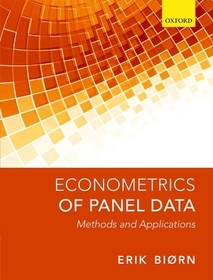
Econometrics of Panel Data
Methods and Applications
- Publisher's listprice GBP 100.00
-
45 150 Ft (43 000 Ft + 5% VAT)
The price is estimated because at the time of ordering we do not know what conversion rates will apply to HUF / product currency when the book arrives. In case HUF is weaker, the price increases slightly, in case HUF is stronger, the price goes lower slightly.
- Discount 10% (cc. 4 515 Ft off)
- Discounted price 40 635 Ft (38 700 Ft + 5% VAT)
Subcribe now and take benefit of a favourable price.
Subscribe
45 150 Ft

Availability
printed on demand
Why don't you give exact delivery time?
Delivery time is estimated on our previous experiences. We give estimations only, because we order from outside Hungary, and the delivery time mainly depends on how quickly the publisher supplies the book. Faster or slower deliveries both happen, but we do our best to supply as quickly as possible.
Product details:
- Publisher OUP Oxford
- Date of Publication 27 October 2016
- ISBN 9780198753445
- Binding Hardback
- No. of pages418 pages
- Size 254x192x27 mm
- Weight 956 g
- Language English
- Illustrations 26 Tables 0
Categories
Short description:
A graduate text on panel data that takes the reader gradually from simple models and methods in scalar (simple vector) notation to more complex models in matrix notation.
MoreLong description:
Panel data is a data type increasingly used in research in economics, social sciences, and medicine. Its primary characteristic is that the data variation goes jointly over space (across individuals, firms, countries, etc.) and time (over years, months, etc.). Panel data allow examination of problems that cannot be handled by cross-section data or time-series data. Panel data analysis is a core field in modern econometrics and multivariate statistics, and studies based on such data occupy a growing part of the field in many other disciplines.
The book is intended as a text for master and advanced undergraduate courses. It may also be useful for PhD-students writing theses in empirical and applied economics and readers conducting empirical work on their own. The book attempts to take the reader gradually from simple models and methods in scalar (simple vector) notation to more complex models in matrix notation. A distinctive feature is that more attention is given to unbalanced panel data, the measurement error problem, random coefficient approaches, the interface between panel data and aggregation, and the interface between unbalanced panels and truncated and censored data sets. The 12 chapters are intended to be largely self-contained, although there is also natural progression.
Most of the chapters contain commented examples based on genuine data, mainly taken from panel data applications to economics. Although the book, inter alia, through its use of examples, is aimed primarily at students of economics and econometrics, it may also be useful for readers in social sciences, psychology, and medicine, provided they have a sufficient background in statistics, notably basic regression analysis and elementary linear algebra.
Table of Contents:
Introduction
Regression Analysis: Fixed Effects Models
Appendix 2A. Properties of GLS
Appendix 2B. Kronecker-product Operations: Examples
Regression Analysis: Random Effects Models
Appendix 3A. Two Theorems related to GLS Estimation
Regression Analysis with Heterogeneous Coefficients
Appendix 4A. Matrix Inversion and Matrix Products: Useful Results
Appendix 4B. A Reinterpretation of the GLS Estimator
Regression Analysis with Uni-Dimensional Variables
Latent Heterogeneity Correlated with Regressors
Appendix 6A. Reinterpretation: Block-Recursive System
Appendix 6B. Proof of Consistency of the Two-Step Estimators
Measurement Errors
Appendix 7A. Asymptotics for Aggregate Estimators
Dynamics Models
Appendix 8A. Within Estimation of the AR Coefficient: Asymptotics
Appendix 8B. Autocovariances and Correlograms ---it and ---it
Analysis of Discrete Response
Appendix 9A. The General Binomial Model: ML Estimation
Appendix 9B. The Multinomial Logit Model: Conditional ML Estimation
Unbalanced Panel Data
Appendix 10A. Between-Estimation: Proofs
Appendix 10B. GLS Estimation: Proofs
Appendix 10C. Estimation of Variance Components: Details
Panel Data with Systematic Unbalance
Appendix 11A. On truncated normal distributions
Appendix 11B. Partial Effects in Censoring Models
Multi-Equation Models
Appendix 12A. Estimating the Error Components Covariance Matrices
Appendix 12B. Matrix Differentiation: Useful Results
Appendix 12C. Estimator Covariance Matrices in Interdependent Model

