

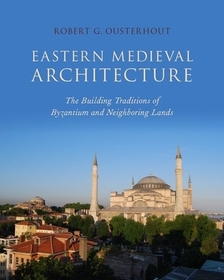
Eastern Medieval Architecture
The Building Traditions of Byzantium and Neighboring Lands
Series: Onassis Series in Hellenic Culture;
- Publisher's listprice GBP 65.00
-
29 347 Ft (27 950 Ft + 5% VAT)
The price is estimated because at the time of ordering we do not know what conversion rates will apply to HUF / product currency when the book arrives. In case HUF is weaker, the price increases slightly, in case HUF is stronger, the price goes lower slightly.
- Discount 10% (cc. 2 935 Ft off)
- Discounted price 26 413 Ft (25 155 Ft + 5% VAT)
Subcribe now and take benefit of a favourable price.
Subscribe
29 347 Ft

Availability
Permanently out of stock
Why don't you give exact delivery time?
Delivery time is estimated on our previous experiences. We give estimations only, because we order from outside Hungary, and the delivery time mainly depends on how quickly the publisher supplies the book. Faster or slower deliveries both happen, but we do our best to supply as quickly as possible.
Product details:
- Publisher OUP USA
- Date of Publication 10 October 2019
- ISBN 9780190272739
- Binding Hardback
- No. of pages816 pages
- Size 208x259x45 mm
- Weight 2472 g
- Language English
- Illustrations 445 color illus., 368 b/w illus., 6 maps 0
Categories
Short description:
The rich and diverse architectural traditions of the Eastern Mediterranean and adjacent regions are the subject of this book, including the social and cultural developments of the Byzantine Empire, the Caucasus, the Balkans, and Russia, as well as parallel developments in Crusader and early Islamic architecture.
MoreLong description:
Aside from Hagia Sophia, the monuments of the Byzantine East are poorly understood today. This is in sharp contrast to the well-known architectural marvels of Western Europes Middle Ages. In this landmark survey, distinguished art historian Robert Ousterhout introduces readers to the rich and diverse architectural traditions of the medieval Eastern Mediterranean.
The focus of the book is the Byzantine (or East Roman) Empire (324-1453 CE), with its capital in Constantinople, although the framework expands chronologically to include the foundations of Christian architecture in Late Antiquity and the legacy of Byzantine culture after the fall of Constantinople in 1453. Geographically broad as well, this study includes architectural developments in areas of Italy, the Caucasus, the Near East, the Balkans, and Russia, as well as related developments in early Islamic architecture. Alternating chapters that address chronological or regionally-based developments with thematic studies that focus on the larger cultural concerns, the book presents the architectural developments in a way that makes them accessible, interesting, and intellectually stimulating. In doing so, it also explains why medieval architecture in the East followed such a different trajectory from that of the West.
Lavishly illustrated with hundreds of color photographs, maps, and line drawings, Eastern Medieval Architecture will establish Byzantine traditions to be as significant and admirable as those more familiar examples in Western Europe, and serve as an invaluable resource for anyone interested in architectural history, Byzantium, and the Middle Ages.
It is without doubt destined to be the standard reference book on Byzantine architecture for the future.
Table of Contents:
Author's Preface
Introduction: Historical Architecture, East and West
Part One: Late Antiquity (fourth to Seventh Centuries)
Chapter One: Rome, the Domus Ecclesiae, and the Church Basilica
Chapter Two: A Tale of Two Cities: Constantinople and Jerusalem in the Time of Constantine
Chapter Three: Ritual Settings I: Liturgy, Initiation, Commemoration
Chapter Four: Ritual Settings II: Pilgrimage, Relics, and Sacred Space
Chapter Five: Makers, Methods, and Materials
Chapter Six: Regional Developments, East and West
Chapter Seven: Secular Architecture: Cities, Houses, and Fortifications
Chapter Eight: Innovative Architecture
Chapter Nine: The Basilica Transformed: Hagia Sophia in Constantinople
Chapter Ten: Justinian's Building Program and Sixth-Century Developments
Part Two: The Transitional Period (seventh to ninth centuries)
Chapter Eleven: The Transitional Period within Byzantium
Chapter Twelve: Transformation at the Edges of Empire
Part Three: The Middle Byzantine Centuries (ninth to twelfth centuries)
Chapter Thirteen: New Church Architecture and the Rise of Monasticism
Chapter Fourteen: Secular Architecture and the Fate of the City
Chapter Fifteen: Constantinople as an Architectural Center
Chapter Sixteen: Master Builders and Their Craft
Chapter Seventeen: Development of Regional Styles I: Middle Byzantine Greece and Macedonia
Chapter Eighteen: Development of Regional Styles II: Middle Byzantine Anatolia
Chapter Nineteen: Development of Regional Styles III: The Caucasus
Chapter Twenty: Contested Lands: Architecture at the Time of the Crusades
Chapter Twenty-One: The Exotic West: Southern Italy, Venice, and Sicily
Chapter Twenty-Two: Exporting a Culture / Importing a Culture: Bulgaria, Kievan Rus' and Serbia
Part Four: The Late Byzantine and Post-Byzantine Centuries (thirteenth to fifteenth centuries)
Chapter Twenty-Three: The Difficult Thirteenth Century
Chapter Twenty-Four: Palaiologan Constantinople and a New Architectural Idiom
Chapter Twenty-Five: Old and New: Greek Cities and Landscapes
Chapter Twenty-Six: Regional Diversity: Bulgaria, Serbia, and Romania
Chapter Twenty-Seven: Rival Powers: The Ottomans and Russia
Epilogue: An Enduring Legacy
Glossary of Terms
Abbreviations
Bibliography
Index

