

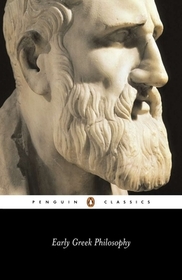
Early Greek Philosophy
Series: Penguin Classics;
- Publisher's listprice GBP 12.99
-
6 205 Ft (5 910 Ft + 5% VAT)
The price is estimated because at the time of ordering we do not know what conversion rates will apply to HUF / product currency when the book arrives. In case HUF is weaker, the price increases slightly, in case HUF is stronger, the price goes lower slightly.
- Discount 15% (cc. 931 Ft off)
- Discounted price 5 275 Ft (5 024 Ft + 5% VAT)
Subcribe now and take benefit of a favourable price.
Subscribe
6 205 Ft

Availability
Estimated delivery time: Expected time of arrival: end of January 2026.
Not in stock at Prospero.
Why don't you give exact delivery time?
Delivery time is estimated on our previous experiences. We give estimations only, because we order from outside Hungary, and the delivery time mainly depends on how quickly the publisher supplies the book. Faster or slower deliveries both happen, but we do our best to supply as quickly as possible.
Product details:
- Edition number 2
- Publisher Penguin Books Ltd
- Date of Publication 26 September 2002
- Number of Volumes B-format paperback
- ISBN 9780140448153
- Binding Paperback
- No. of pages336 pages
- Size 197x128x19 mm
- Weight 248 g
- Language English 0
Categories
Long description:
The works collected in this volume form the true foundation of Western philosophy - the base upon which Plato and Aristotle and their successors would eventually build. Yet the importance of the Pre-Socratics thinkers lies less in their influence - great though that was - than in their astonishing intellectual ambition and imaginative reach. Zeno's dizzying 'proofs' that motion is impossible; the extraordinary atomic theories of Democritus; the haunting and enigmatic epigrams of Heraclitus; and the maxims of Alcmaeon: fragmentary as they often are, the thoughts of these philosophers seem strikingly modern in their concern to forge a truly scientific vocabulary and way of reasoning.
More
