

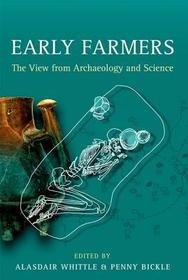
Early Farmers
The View from Archaeology and Science
Series: Proceedings of the British Academy; 198;
- Publisher's listprice GBP 95.00
-
42 892 Ft (40 850 Ft + 5% VAT)
The price is estimated because at the time of ordering we do not know what conversion rates will apply to HUF / product currency when the book arrives. In case HUF is weaker, the price increases slightly, in case HUF is stronger, the price goes lower slightly.
- Discount 10% (cc. 4 289 Ft off)
- Discounted price 38 603 Ft (36 765 Ft + 5% VAT)
Subcribe now and take benefit of a favourable price.
Subscribe
42 892 Ft

Availability
Estimated delivery time: In stock at the publisher, but not at Prospero's office. Delivery time approx. 3-5 weeks.
Not in stock at Prospero.
Why don't you give exact delivery time?
Delivery time is estimated on our previous experiences. We give estimations only, because we order from outside Hungary, and the delivery time mainly depends on how quickly the publisher supplies the book. Faster or slower deliveries both happen, but we do our best to supply as quickly as possible.
Product details:
- Publisher The British Academy
- Date of Publication 13 November 2014
- ISBN 9780197265758
- Binding Hardback
- No. of pages486 pages
- Size 240x165x11 mm
- Weight 998 g
- Language English
- Illustrations Numerous figures and tables 0
Categories
Short description:
Archaeology and science enable new and creative understandings of Europe's early farmers, answering questions that remain after more than a century of research. The challenge is to integrate multiple lines of evidence, scientific and more traditionally archaeological, while keeping in focus the principal questions that we want to ask of our data.
MoreLong description:
The Neolithic period was one of the great transformations in human history with profound, long-term consequences. In Europe, there were no farmers at 7000 cal BC, but very few hunter-gatherers after about 4000 cal BC. Although we understand the broad chronological structure of this shift, many pressing research questions remain. Archaeologists are still vigorously debating the identity of those principally involved in initiating change, the detail of everyday lives during the Neolithic, including basic questions about settlement, the operation of the farming economy and the varied roles of material culture, and the character of large-scale and long-term transformations. They face the task not only of working at different scales, but of integrating ever-expanding amounts of evidence.
As well as the data coming from larger and more intensive excavations, there has been a radical increase in the information released by many kinds of scientific analysis of archaeological remains. These now include, alongside longer established methods of looking at food remains and material, the isotopic analysis of the diet and lifetime movement of people, isotopic analysis of cereal remains for indications of manuring, a DNA analysis of genetic signatures, detailed micromorphological analysis of deposits where people lived, and the close examination of the origin and production of varying materials and artefacts.
The 21 chapters by leading experts in the field demonstrate how the combination of archaeological and scientific evidence now provides opportunities for new and creative understandings of Europe's early farmers. They make an important contribution to the debate over how best to integrate these multiple lines of evidence, scientific and more traditionally archaeological, while keeping in central focus the principal questions that we want to ask of our data.
this book will be of keen interest to prehistorians rethinking the way they understand one of the most innovative periods of human history. More
Table of Contents:
- 1: Penny Bickle and Alasdair Whittle: Introduction: integrated and multi-scalar approaches to early farmers in Europe
- 2: John Robb: The future Neolithic: a new research agenda
- 3: John C. Barrett: Some possible conditions necessary for the colonisation of Europe by domesticates
- 4: Jean-Pierre Bocquet-Appel, Jérôme Dubouloz, Richard Moussa, Jean-François Berger, Anne Tresset, Elena Ortu, Jean-Denis Vigne, Robin Bendrey, Stéphanie Bréhard, Dominique Schwartz, Aurélie Salavert, Maria Fernanda Sanchez-Goñi, Damien Ertlen, Yoan Gauvry, Gourguen Davtian, Marc Vander Linden, Eva Lenneis, Lorette Noiret, Agnès Guillaumont and Martin O'Connor: Multi-agent modeling of the trajectory of the LBK Neolithic: a study in progress
- 5: Anna Szécsényi-Nagy, Victoria Keerl, János Jakucs, Guido Brandt, Eszter Bánffy and Kurt W. Alt: Ancient DNA evidence for a homogeneous maternal gene pool in sixth millennium cal BC Hungary and the central European LBK
- 6: Guido Brandt, Corina Knipper, Nicole Nicklisch, Robert Ganslmeier, Mechthild Klamm, Kurt W. Alt: Settlement burials at the Karsdorf LBK site, Saxony-Anhalt, Germany: biological ties and residential mobility
- 7: Marie Balasse, Carlos Tornero, Stéphanie Brehard, Joël Ughetto-Monfrin, Valentina Voinea and Adrian Balasescu: Cattle and sheep herding at Cheia, Romania, at the turn of the fifth millennium cal BC: a view from stable isotope analysis
- 8: Mary Anne Tafuri, John Robb, Maria Giovanna Belcastro, Valentina Mariotti, Paola Iacumin, Antonietta Di Matteo and Tamsin O'Connell: Herding practices in the ditched villages of the Neolithic Tavoliere (Apulia, SE Italy): a vicious circle? The isotopic evidence.
- 9: Lamys Hachem and Caroline Hamon: Linear Pottery culture household organisation: an economic model
- 10: Amy Boggard: Framing farming: a multi-stranded approach to early agricultural practice in Europe
- 11: Hayley Saul, Aikaterini Glykou and Oliver E. Craig: Stewing on a theme of cuisine: biomolecular and interpretative approaches to culinary changes at the transition to agriculture
- 12: Clark Spencer Larsen: Life conditions and health in early farmers: a global perspective on costs and consequences of a fundamental transition
- 13: Jessica Pearson and Lynn Meskell: Biographical bodies: flesh and food at Çatalhöyük
- 14: Wendy Matthews, Lisa-Marie Shillito and Sarah Elliott: Neolithic lifeways: microstratigraphic traces within houses, animal pens and settlements
- 15: Rick Schulting and Linda Fibiger: Violence in the Neolithic: a population perspective
- 16: Christian Meyer, Christian Lohr, Olaf Kürbis, Veit Dresely, Wolfgang Haak, Christina J. Adler, Detlef Gronenborn and Kurt W. Alt: Mass graves of the LBK: patterns and peculiarities
- 17: Oliver J.T. Harris: Revealing our vibrant past: science, materiality and the Neolithic
- 18: Jessica Smyth and Richard Evershed: Pottery, Archaeology and Chemistry: contents and context
- 19: Alison Sheridan and Pierre Pétrequin: Constructing a narrative for the Neolithisation of Britain and Ireland: the use of 'hard science' and archaeological reasoning
- 20: John Chapman: Doing science in the Mesolithic, Neolithic and Copper Age: an insider's perspective
- 21: Paul Halstead: Archaeological science and the Neolithic: the power and perils of proxy measures

