

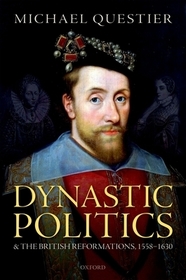
Dynastic Politics and the British Reformations, 1558-1630
- Publisher's listprice GBP 55.00
-
24 832 Ft (23 650 Ft + 5% VAT)
The price is estimated because at the time of ordering we do not know what conversion rates will apply to HUF / product currency when the book arrives. In case HUF is weaker, the price increases slightly, in case HUF is stronger, the price goes lower slightly.
- Discount 10% (cc. 2 483 Ft off)
- Discounted price 22 349 Ft (21 285 Ft + 5% VAT)
Subcribe now and take benefit of a favourable price.
Subscribe
24 832 Ft

Availability
Estimated delivery time: In stock at the publisher, but not at Prospero's office. Delivery time approx. 3-5 weeks.
Not in stock at Prospero.
Why don't you give exact delivery time?
Delivery time is estimated on our previous experiences. We give estimations only, because we order from outside Hungary, and the delivery time mainly depends on how quickly the publisher supplies the book. Faster or slower deliveries both happen, but we do our best to supply as quickly as possible.
Product details:
- Publisher OUP Oxford
- Date of Publication 31 January 2019
- ISBN 9780198826330
- Binding Hardback
- No. of pages518 pages
- Size 236x164x32 mm
- Weight 898 g
- Language English 0
Categories
Short description:
During the later sixteenth and early seventeenth centuries, it was usual to consolidate power through lines of royal succession and marriage into other royal and princely families. Michael Questier shows that while this secured political power, it also caused a lot of religious upheaval in this period of already-fraught western Christendom.
MoreLong description:
Dynastic Politics and the British Reformations, 1558-1630 revisits what used to be regarded as an entirely 'mainstream' topic in the historiography of the later sixteenth and early seventeenth centuries - namely, the link between royal dynastic politics and the outcome of the process usually referred to as 'the Reformation'. As everyone knows, the principal mode of transacting so much of what constituted public political activity in the early modern period, and especially of securing something like political obedience if not exactly stability, was through the often distinctly un-modern management of the crown's dynastic rights, via the line of royal succession and in particular through matching into other royal and princely families. Dynastically, the states of Europe resembled a vast sexual chess board on which the trick was to preserve, advance, and then match (to advantage) one's own most powerful pieces. This process and practice were, obviously, not unique to the sixteenth and seventeenth centuries. But the changes in religion generated by the discontents of western Christendom in the Reformation period made dynastic politics ideologically fraught in a way which had not been the case previously, in that certain modes of religious thought were now taken to reflect on, critique, and hinder this mode of exercising monarchical authority, sometimes even to the extent of defining who had the right to be king or queen.
Michael Questier's new book is proudly old-fashioned, offering a narrative history of dynastic politics-the business of monarchical succession, royal marriages, and intradynastic alliance-in the Elizabethan,Marian, Jacobean, and early Caroline Britannic Isles. In other ways, the book is defiantly original.
Table of Contents:
Preface
The Elizabethan Settlement, the Issue of the Royal Succession, and the Emergence of Religious Dissent, c. 1558-1571
Puritans, Catholics, and Dynastic Crises, 1571-1582
Protestant Foreign Policy and the Coming of War, 1582-1593
European Politics and the Stuart Succession in England, 1593-1603
The Accession of James Stuart and the Kingdom of Great Britain, 1603-1610
The Jacobean Polity and the Failure of Via Media Politics, 1611-1620
Dynastic Marriage Diplomacy, Parliamentary Conflict, Peace and War, 1621-1629
Conclusion: Into the Personal Rule of Charles I

