

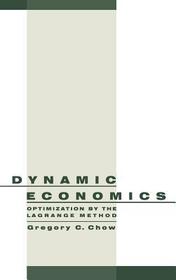
Dynamic Economics
Optimization by the Lagrange Method
- Publisher's listprice GBP 120.00
-
54 180 Ft (51 600 Ft + 5% VAT)
The price is estimated because at the time of ordering we do not know what conversion rates will apply to HUF / product currency when the book arrives. In case HUF is weaker, the price increases slightly, in case HUF is stronger, the price goes lower slightly.
- Discount 10% (cc. 5 418 Ft off)
- Discounted price 48 762 Ft (46 440 Ft + 5% VAT)
Subcribe now and take benefit of a favourable price.
Subscribe
54 180 Ft

Availability
printed on demand
Why don't you give exact delivery time?
Delivery time is estimated on our previous experiences. We give estimations only, because we order from outside Hungary, and the delivery time mainly depends on how quickly the publisher supplies the book. Faster or slower deliveries both happen, but we do our best to supply as quickly as possible.
Product details:
- Publisher OUP USA
- Date of Publication 3 April 1997
- ISBN 9780195101928
- Binding Hardback
- No. of pages248 pages
- Size 229x169x21 mm
- Weight 567 g
- Language English
- Illustrations line figures, tables 0
Categories
Short description:
This book provides a unified and simple treatment of dynamic economics using dynamic optimization as the main theme, and the method of Lagrange multipliers to solve dynamic economic problems.
MoreLong description:
This work provides a unified and simple treatment of dynamic economics using dynamic optimization as the main theme, and the method of Lagrange multipliers to solve dynamic economic problems. The author presents the optimization framework for dynamic economics in order that readers can understand the approach and use it as they see fit. Instead of using dynamic programming, the author chooses instead to use the method of Lagrange multipliers in the analysis of dynamic optimization because it is easier and more efficient than dynamic programming, and allows readers to understand the substance of dynamic economics better.
The author treats a number of topics in economics, including economic growth, macroeconomics, microeconomics, finance and dynamic games. The book also teaches by examples, using concepts to solve simple problems; it then moves to general propositions.
Chow's book is significant. Chow's book is clear and well written, and covers an enormous range of applications of dynamic optimisation. For a postgraduate student or professional economist who is convinced by Chow's argument about the superiority of the Lagrange multiplier method and wants to use it, his book would undoubtedly be the best buy. - Paul Oslington. Economic Record. September 1998.

