

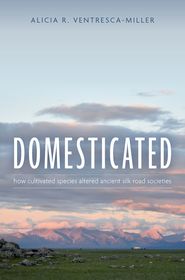
Domesticated
How Cultivated Species Altered Ancient Silk Road Societies
- Publisher's listprice GBP 68.00
-
30 702 Ft (29 240 Ft + 5% VAT)
The price is estimated because at the time of ordering we do not know what conversion rates will apply to HUF / product currency when the book arrives. In case HUF is weaker, the price increases slightly, in case HUF is stronger, the price goes lower slightly.
- Discount 10% (cc. 3 070 Ft off)
- Discounted price 27 632 Ft (26 316 Ft + 5% VAT)
Subcribe now and take benefit of a favourable price.
Subscribe
30 702 Ft

Availability
Estimated delivery time: In stock at the publisher, but not at Prospero's office. Delivery time approx. 3-5 weeks.
Not in stock at Prospero.
Why don't you give exact delivery time?
Delivery time is estimated on our previous experiences. We give estimations only, because we order from outside Hungary, and the delivery time mainly depends on how quickly the publisher supplies the book. Faster or slower deliveries both happen, but we do our best to supply as quickly as possible.
Product details:
- Publisher OUP USA
- Date of Publication 5 May 2026
- ISBN 9780197785942
- Binding Hardback
- No. of pages296 pages
- Size 244x160x25 mm
- Weight 544 g
- Language English 684
Categories
Short description:
Domesticated uses novel archaeological methods to rewrite the narrative of the rise of social complexity in the western and eastern Eurasian steppe. Through the study of ancient proteins, DNA, and isotopes, as well as traditional archaeology, it tracks the adoption of domesticated animals and plants to show how cultivated species transformed societies during the eras preceding the Silk Road networks.
MoreLong description:
This is an open access title available under the terms of a CC BY-NC-ND 4.0 International licence. It is free to read at Oxford Academic and offered as a free PDF download from OUP and selected open access locations.
Domesticated uses novel archaeological methods to rewrite the narrative of the rise of social complexity in the western and eastern Eurasian steppe. Through the study of ancient proteins, DNA, and isotopes, as well as traditional archaeology, Alicia R. Ventresca-Miller tracks the adoption of domesticated animals and plants to show how cultivated species transformed societies during the eras preceding the Silk Road networks. Economies in this region shifted from hunting and gathering to the use of ruminant livestock, horse dairying and riding, and finally to the cultivation of grains, marking major thresholds in human history. Ventresca-Miller proposes a model for how this happened--from the initial introduction of the animal or plant to their acceptance, solidification, and intensification--and shows how each stage of development impacted the ways local communities interacted, settled in the landscape, and gave rise to new social structures.
The management of domesticated species and the alteration of landscapes allowed communities in north-central Asia to build complex societies and long-distance trading networks, which linked cities and supported Empires. In Domesticated, a nuanced narrative emerges, one that situates north-central Asia as a vital locale for the study of the adoption of domesticated species and underscores how these developments contributed to alternative forms of social complexity.
08/12/2025
Table of Contents:
Fueling Complexity: Trajectories of Ancient Societies in North-Central Asia
Landscapes of Foraging and Fishing
The Appropriation of Grasslands by Early Herders
Putting the Cart Before the Horse
Cultivating Complexity
How Domesticates Fueled the Rise of the Silk Roads

