

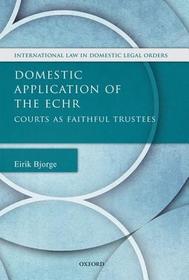
Domestic Application of the ECHR
Courts as Faithful Trustees
Series: International Law and Domestic Legal Orders;
- Publisher's listprice GBP 145.00
-
65 467 Ft (62 350 Ft + 5% VAT)
The price is estimated because at the time of ordering we do not know what conversion rates will apply to HUF / product currency when the book arrives. In case HUF is weaker, the price increases slightly, in case HUF is stronger, the price goes lower slightly.
- Discount 10% (cc. 6 546 Ft off)
- Discounted price 58 921 Ft (56 115 Ft + 5% VAT)
Subcribe now and take benefit of a favourable price.
Subscribe
65 467 Ft

Availability
printed on demand
Why don't you give exact delivery time?
Delivery time is estimated on our previous experiences. We give estimations only, because we order from outside Hungary, and the delivery time mainly depends on how quickly the publisher supplies the book. Faster or slower deliveries both happen, but we do our best to supply as quickly as possible.
Product details:
- Publisher OUP Oxford
- Date of Publication 22 October 2015
- ISBN 9780198743637
- Binding Hardback
- No. of pages294 pages
- Size 241x170x22 mm
- Weight 602 g
- Language English 0
Categories
Short description:
The first sustained critique of how domestic courts in the EU apply the European Convention on Human Rights and interact with the European Court of Human Rights at Strasbourg. This book considers the British, French, and German approaches to the ECHR and shows that domestic courts apply and develop the Convention faithfully and positively.
MoreLong description:
Domestic courts are entrusted with the application of the European Convention on Human Rights (ECHR), as faithful trustees of the rights protected in the Convention.
This book analyses the way in which the domestic courts in the United Kingdom, France, and Germany apply the ECHR and how, applying the Convention, they define their relationship with the European Court of Human Rights. Contrary to what others have contended, the book argues that it is not true descriptively, nor desirable normatively, that the domestic courts approach the ECHR based upon friction and assertion of sovereignty vis-à-vis the European Court. The proper role played by the domestic courts, and the one which they have taken on them to perform in fact, is to apply the Convention in all good faith, building on the principles of the Convention as set out in the jurisprudence of the European Court. But if domestic courts are in a position to apply the ECHR in the first place, it is because the application of the Convention has been entrusted to them by the other organs of the municipal state; in certain cases municipal principles of the separation of powers have an important bearing on domestic interpretation and application of the Convention.
Domestic Application of the ECHR: Courts as Faithful Trustees shows that, through their faithful application of the ECHR, domestic courts can - and do - make a positive contribution to the development of the law of the Convention.
The immense strength of Bjorges study is that it both demonstrates that the tensions between the European Court and the domestic authorities are commonplace across the Council of Europe and identifies the way to its effective resolution: that Strasbourg can only succeed in achieving a subsidiary role if domestic courts perform the critical duty of securing human rights protection at home.
Table of Contents:
Introduction
Thesis of the Book
Incorporation: Conceptual Relationship between ECHR and National Law
Evolutionary Interpretation: 'The Convention is a Living Instrument'
Proportionality
Margin of Appreciation
Autonomous Concepts
Dialogue
Conclusion

