

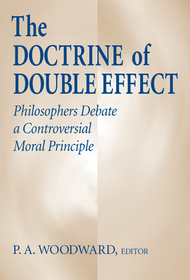
Doctrine of Double Effect, the
Philosophers Debate a Controversial Moral Principle
- Publisher's listprice GBP 22.99
-
10 983 Ft (10 460 Ft + 5% VAT)
The price is estimated because at the time of ordering we do not know what conversion rates will apply to HUF / product currency when the book arrives. In case HUF is weaker, the price increases slightly, in case HUF is stronger, the price goes lower slightly.
- Discount 10% (cc. 1 098 Ft off)
- Discounted price 9 885 Ft (9 414 Ft + 5% VAT)
Subcribe now and take benefit of a favourable price.
Subscribe
10 983 Ft

Availability
Estimated delivery time: In stock at the publisher, but not at Prospero's office. Delivery time approx. 3-5 weeks.
Not in stock at Prospero.
Why don't you give exact delivery time?
Delivery time is estimated on our previous experiences. We give estimations only, because we order from outside Hungary, and the delivery time mainly depends on how quickly the publisher supplies the book. Faster or slower deliveries both happen, but we do our best to supply as quickly as possible.
Product details:
- Publisher University of Notre Dame Press
- Date of Publication 4 May 2001
- Number of Volumes Print PDF
- ISBN 9780268008970
- Binding Paperback
- No. of pages328 pages
- Size 229x152x19 mm
- Weight 481 g
- Language English 0
Categories
Long description:
"
This anthology of philosophical essays, gathered from numerous sources, provides a convenient, in-depth introduction to the Doctrine of Double Effect. A number of important philosophers and intellectual perspectives are represented in what constitutes a debate over the doctrine and the various concerns it raises. Philosophers represented in these readings include Joseph M. Boyle, Jr., Warren Quinn, G. E. M. Anscombe, Thomas Nagel, Phillippa Foot, Jonathan Bennett, Nancy Davis, Donald Marquis, and many others.
The Doctrine of Double Effect is a principle of reasoning well known to moral philosophers. The standard formulation of the doctrine states that it is ""licit to posit a cause which is either good or indifferent from which there follows a twofold effect, one good, the other evil, if a proportionally grave reason is present, and if the end of the agent is honorable.""
According to this doctrine, an effect that would be considered morally wrong if it were the intentional outcome of an act could be morally permissible if it were the unintended effect of that act, even if it had been foreseen. As a method of drawing moral distinctions between the intentional and unintentional production of evil, the doctrine has had a long history. It has often been employed, for example, in debates about ""just war"" and the kinds of acts that are permissible in war.
The first section of this collection offers an introduction to the doctrine, its purpose, its claims, and the issues it raises for moral philosophers. Sections two and three take the form of a debate by several influential thinkers about the validity of the doctrine and the many problems surrounding it. The authors in section two defend the doctrine; those in section three oppose it. Sections four and five focus on applications, concrete and theoretical, of the doctrine, showing its possible uses and misuses.
This book will be valuable to teachers and students of philosophy as well as others interested in a clear understanding of this controversial doctrine.
Contributors: G. E. M. Anscombe, Greg Beabout, Jonathan Bennett, Joseph M. Boyle, Jr., William Cooney, David Copp, Nancy Davis, Stanislaus J. Dundon, John Martin Fischer, Philippa Foot, Jeff Jordan, Donald B. Marquis, Robert M. Martin, Thomas Nagel, Warren S. Quinn, Mark Ravizza, Michael Walzer, and P. A. Woodward.
" More
