

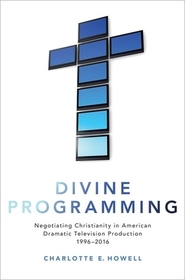
Divine Programming
Negotiating Christianity in American Dramatic Television Production 1996-2016
- Publisher's listprice GBP 41.99
-
20 060 Ft (19 105 Ft + 5% VAT)
The price is estimated because at the time of ordering we do not know what conversion rates will apply to HUF / product currency when the book arrives. In case HUF is weaker, the price increases slightly, in case HUF is stronger, the price goes lower slightly.
- Discount 10% (cc. 2 006 Ft off)
- Discounted price 18 054 Ft (17 195 Ft + 5% VAT)
Subcribe now and take benefit of a favourable price.
Subscribe
20 060 Ft

Availability
printed on demand
Why don't you give exact delivery time?
Delivery time is estimated on our previous experiences. We give estimations only, because we order from outside Hungary, and the delivery time mainly depends on how quickly the publisher supplies the book. Faster or slower deliveries both happen, but we do our best to supply as quickly as possible.
Product details:
- Publisher OUP USA
- Date of Publication 2 June 2020
- ISBN 9780190054380
- Binding Paperback
- No. of pages288 pages
- Size 155x231x17 mm
- Weight 408 g
- Language English
- Illustrations 10 figures 17
Categories
Short description:
In Divine Programming, author Charlotte E. Howell investigates the disconnect between dramatic television narratives of white Christianity and the religion they are meant to represent, focusing on key series including 7th Heaven, Friday Night Lights, Supernatural, Jane the Virgin, and Daredevil.
MoreLong description:
From the mid-90s to the present, television drama with religious content has come to reflect the growing cultural divide between white middle-America and concentrated urban elites. As author Charlotte E. Howell argues in this book, by 2016, television narratives of white Christianity had become entirely disconnected from the religion they were meant to represent. Programming labeled 'family-friendly' became a euphemism for white, middlebrow America, and developing audience niches became increasingly significant to serial dramatic television. Utilizing original case studies and interviews, Divine Programming investigates the development, writing, producing, marketing, and positioning of key series including 7th Heaven, Friday Night Lights, Rectify, Supernatural, Jane the Virgin, Daredevil, and Preacher.
As this book shows, there has historically been a deep ambivalence among television production cultures regarding religion and Christianity more specifically. It illustrates how middle-American television audiences lost significance within the Hollywood television industry and how this in turn has informed and continues to inform television programming on a larger scale. In recent years, upscale audience niches have aligned with the perceived tastes of affluent, educated, multicultural, and-importantly-secular elites. As a result, the televised representation of white Christianity had to be othered, and shifted into the unreality of fantastic genres to appeal to niche audiences. To examine this effect, Howell looks at religious representation through four approaches - establishment, distancing, displacement, and use - and looks at series across a variety of genres and outlets in order to provied varied analyses of each theme.
...Howell's research and interviews help us see inside the minds of those who create the media, images, and narratives society engages with on a daily basis.
Table of Contents:
List of Figures
Introduction: Christianity, Religion, and Hollywood Television Production Cultures
Two Preachers, 2016 and 1996
Understanding Religion in Hollywood's Production Culture
The Boom in Religious Representation in the Post-Network Era (early 2000s-2016)
Religion Among Expansive Options: Toward Peak TV (2015-2016)
Methods and Chapters
Part One: Establishing White Christianity's Middlebrow Associations
Chapter One - Christianity's Broad Appeal in the 1990s: Touched by an Angel and 7th Heaven
A Brief History: Establishing The Norms of Representing Christianity on American Television
The Neo-Network Legacy: Defining and Avoiding "Religious TV" Within Middlebrow Appeal
Old Networks and New Netlets: Broadcast in the Neo-Network Era
Religious Messages and the Middlebrow Audience: Touched by an Angel
Attempting to Avoid "Preachy" : 7th Heaven
Conclusion
Chapter Two - Biblical Miniseries in the 2010s: Mark Burnett, Roma Downey, and Faithful Christian Representation
Touched by an Angel as Model: Roma Downey and Mark Burnett's Pursuit of Faithful TV in an Increasingly Upscale-oriented Industry
The Bible Miniseries: The Rewards of Risk for the History Channel
A.D.: The Bible Continues and The Dovekeepers: Failures of Faith on Network Television
The Persistent Perception of Antagonism between Faith and Mainstream Television
Part Two: Distancing Christianity Through Place and Race
Chapter Three - Southern Realism: Christianity in Friday Night Lights and Rectify
Christianity in Quality Representations of the American South
Southern Realism and Authenticity Claims in the Post-Network Era
Heartland Subjects, Quality Audience: Friday Night Lights
Authentic Artistic Vision, Quality Channel: Rectify
Conclusion
Chapter Four - Non-White Christian Dramas: Exploration through Otherness in Jane the Virgin and Greenleaf
Latinx Catholicism on TV
The Tele-Novelty of Jane the Virgin's Catholicism
Christianity and Black TV Identity
Oprah's Soap Opera on the Megachurch Pulpit: Greenleaf
Conclusion
Part Three: Displacing Christianity in Fantastic Genres
Chapter Five - Religion as Unreality: Fantastic TV's Generic Displacement of Christianity
Containment Through Displacement: Battlestar Galactica
Abstraction to Supernatural Spirituality: Lost
Minimizing Genre, Maximizing Quality: The Leftovers
Adapting Edginess and the Pursuit of God: Preacher
Conclusion
Chapter Six - The Biblical Book of Revelation as Mythology: Apocalyptic TV
The Post-Christian End of the World and Apocalyptic Television
Containment Through Pastiche: Supernatural
Containment Through Denial: Dominion and Constantine
Conclusion
Part Four: Acknowledging Christianity in the Era of Peak TV
Chapter Seven - Streaming Religion: Netflix's Daredevil and Amazon's Hand of God
Peak TV is Still TV: New Television, Old Ideologies
Netflix and Amazon: History, Branding, and Models of Success in a Changing Industry
Religion in the Context of Marvel's Brand: Daredevil
Religion to Cultivate Edge: Amazon's Hand of God
Conclusion
Conclusion - Polarized Culture and Dual Approaches to Christianity on TV
The Tipping Point
Appendix A: Interviews
Bibliography

