

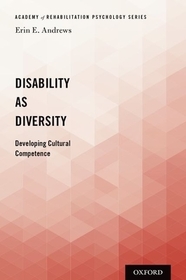
Disability as Diversity
Developing Cultural Competence
Series: Academy of Rehabilitation Psychology;
- Publisher's listprice GBP 48.49
-
21 893 Ft (20 850 Ft + 5% VAT)
The price is estimated because at the time of ordering we do not know what conversion rates will apply to HUF / product currency when the book arrives. In case HUF is weaker, the price increases slightly, in case HUF is stronger, the price goes lower slightly.
- Discount 20% (cc. 4 379 Ft off)
- Discounted price 17 514 Ft (16 680 Ft + 5% VAT)
- Discount is valid until: 30 June 2026
Subcribe now and take benefit of a favourable price.
Subscribe
21 893 Ft

Availability
Estimated delivery time: In stock at the publisher, but not at Prospero's office. Delivery time approx. 3-5 weeks.
Not in stock at Prospero.
Why don't you give exact delivery time?
Delivery time is estimated on our previous experiences. We give estimations only, because we order from outside Hungary, and the delivery time mainly depends on how quickly the publisher supplies the book. Faster or slower deliveries both happen, but we do our best to supply as quickly as possible.
Product details:
- Publisher OUP USA
- Date of Publication 7 January 2020
- ISBN 9780190652319
- Binding Paperback
- No. of pages240 pages
- Size 155x231x15 mm
- Weight 318 g
- Language English 0
Categories
Short description:
Disability as Diversity: Developing Cultural Competence is the first book to comprehensively address disability as diversity and provide a guide for developing cultural competence. The text goes beyond disability models, and opens a discourse on concepts such as disability identity development and culture, and culturally appropriate language, assessment, and intervention. Readers will gain an appreciation of the role of cultural competence on health disparities, health promotion, and disease prevention for disability across the lifespan. This volume is designed to equip professionals with heightened awareness, knowledge, and skills to enhance the provision of culturally competent care to disabled people.
MoreLong description:
Disability as Diversity: Developing Cultural Competence reveals why disability is a cultural experience, rather than merely a medical status. Conceptual models of disability have evolved into a complex biopsychosocial phenomenon that disability service providers must understand to fully appreciate the intricacy of the lives of the people they serve. In this volume, Andrews sets the stage with the must-know history of disability rights and the social and cultural evolution of disabled people in the United States. She presents important concepts about attitudes toward disability and the impact of ableism. Andrews illustrates that not only are negative attitudes harmful, but that overly positive stereotypes can have an equally detrimental effect on disabled people. The reader will learn about disability microaggressions and how attempts to improve disability awareness can be misguided. Andrews argues that there is a distinct disability culture, and introduces the reader to its characteristics and features. She explores the concept of disability identity development, and how some people with disabilities identify readily as disabled and embrace the disability community, while others do not view themselves as disabled even though they meet commonly accepted criteria for disability. Andrews delves into the intricacies and controversies of disability language, including person-first and identity-first language. The reader will gain enhanced knowledge and skills to provide culturally competent care to individuals, as well as methods to enrich cultural humility at the organizational level. Andrews offers readers a guide to disability-related considerations for psychological testing and assessment and the role of universal design. Readers will learn about specific considerations for intervention with children and adults with disabilities, including how to tailor intervention approaches, clinician attitudes, and the use of evidence based treatments. Researchers will find a thorough exploration of the challenges inherent in disability research, the importance of full consumer inclusion, and future directions to reduce health disparities based on disability. This book offers practical suggestions for clinicians and researchers who work with people with disabilities in order to be culturally effective in all aspects of assessment, intervention, and scientific inquiry.
Well-written volume... Highly recommended. All readers.
Table of Contents:
Chapter 1 - History
Chapter 2 - Models of Disability
Chapter 3 - Attitudes and Ableism
Chapter 4 - Disability Culture
Chapter 5 - Disability Language
Chapter 6 - Disability Identity Development
Chapter 7 - Cultural Competence
Chapter 8 - Providing Culturally Competent Testing and Assessment
Chapter 9 - Providing Culturally Competent Intervention
Chapter 10 - Conducting Culturally Competent Disability Research
References
Index

