

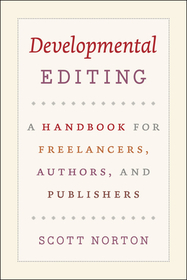
Developmental Editing ? A Handbook for Freelancers, Authors, and Publishers
A Handbook for Freelancers, Authors, and Publishers
Series: Chicago Guides to Writing, Editing and Publishing;
- Publisher's listprice GBP 24.00
-
10 836 Ft (10 320 Ft + 5% VAT)
The price is estimated because at the time of ordering we do not know what conversion rates will apply to HUF / product currency when the book arrives. In case HUF is weaker, the price increases slightly, in case HUF is stronger, the price goes lower slightly.
- Discount 10% (cc. 1 084 Ft off)
- Discounted price 9 752 Ft (9 288 Ft + 5% VAT)
Subcribe now and take benefit of a favourable price.
Subscribe
10 836 Ft

Availability
Out of print
Why don't you give exact delivery time?
Delivery time is estimated on our previous experiences. We give estimations only, because we order from outside Hungary, and the delivery time mainly depends on how quickly the publisher supplies the book. Faster or slower deliveries both happen, but we do our best to supply as quickly as possible.
Product details:
- Publisher University of Chicago Press
- Date of Publication 2 December 2011
- ISBN 9780226595153
- Binding Paperback
- No. of pages256 pages
- Size 229x152x14 mm
- Weight 365 g
- Language English 0
Categories
Short description:
Editing is a tricky business. It requires analytical flair and creative panache, the patience of a saint and the vision of a writer. Transforming a manuscript into a book that edifies, inspires, and sells? That's the job of the developmental editor, whose desk is the first stop for many manuscripts on the road to bookdom ? a route ably mapped out in the pages of "Developmental Editing".
Author Scott Norton has worked with a diverse range of authors, editors, and publishers, and his handbook provides an approach to developmental editing that is logical, collaborative, humorous, and realistic. He starts with the core tasks of shaping the proposal, finding the hook, and building the narrative or argument, and then turns to the hard work of executing the plan and establishing a style.
"Developmental Editing" includes detailed case studies featuring a variety of nonfiction books ? election-year polemic, popular science, memoir, travel guide ? and authors ranging from first-timer to veteran, journalist to scholar. Handy sidebars offer advice on how to become a developmental editor, create effective illustration programs, and adapt sophisticated fiction techniques (such as point of view, suspense, plotting, character, and setting) to nonfiction writing.
Norton's book also provides freelance copyeditors with a way to earn higher fees while introducing more creativity into their work lives. It gives acquisitions, marketing, and production staff a vocabulary for diagnosing a manuscript's flaws and techniques for transforming it into a bestseller. And perhaps most importantly, "Developmental Editing" equips authors with the concrete tools they need to reach their audiences.
Long description:
Editing is a tricky business. It requires analytical flair and creative panache, the patience of a saint and the vision of a writer. Transforming a manuscript into a book that edifies, inspires, and sells? That's the job of the developmental editor, whose desk is the first stop for many manuscripts on the road to bookdom ? a route ably mapped out in the pages of "Developmental Editing".
Author Scott Norton has worked with a diverse range of authors, editors, and publishers, and his handbook provides an approach to developmental editing that is logical, collaborative, humorous, and realistic. He starts with the core tasks of shaping the proposal, finding the hook, and building the narrative or argument, and then turns to the hard work of executing the plan and establishing a style.
"Developmental Editing" includes detailed case studies featuring a variety of nonfiction books ? election-year polemic, popular science, memoir, travel guide ? and authors ranging from first-timer to veteran, journalist to scholar. Handy sidebars offer advice on how to become a developmental editor, create effective illustration programs, and adapt sophisticated fiction techniques (such as point of view, suspense, plotting, character, and setting) to nonfiction writing.
Norton's book also provides freelance copyeditors with a way to earn higher fees while introducing more creativity into their work lives. It gives acquisitions, marketing, and production staff a vocabulary for diagnosing a manuscript's flaws and techniques for transforming it into a bestseller. And perhaps most importantly, "Developmental Editing" equips authors with the concrete tools they need to reach their audiences.

