

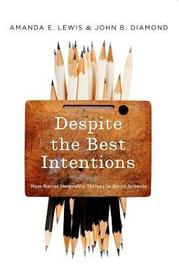
Despite the Best Intentions
How Racial Inequality Thrives in Good Schools
Series: Transgressing Boundaries: Studies in Black Politics and Black Communities;
- Publisher's listprice GBP 25.49
-
11 508 Ft (10 960 Ft + 5% VAT)
The price is estimated because at the time of ordering we do not know what conversion rates will apply to HUF / product currency when the book arrives. In case HUF is weaker, the price increases slightly, in case HUF is stronger, the price goes lower slightly.
- Discount 10% (cc. 1 151 Ft off)
- Discounted price 10 357 Ft (9 864 Ft + 5% VAT)
Subcribe now and take benefit of a favourable price.
Subscribe
11 508 Ft

Availability
printed on demand
Why don't you give exact delivery time?
Delivery time is estimated on our previous experiences. We give estimations only, because we order from outside Hungary, and the delivery time mainly depends on how quickly the publisher supplies the book. Faster or slower deliveries both happen, but we do our best to supply as quickly as possible.
Product details:
- Publisher OUP USA
- Date of Publication 8 June 2017
- ISBN 9780190669829
- Binding Paperback
- No. of pages272 pages
- Size 231x152x17 mm
- Weight 386 g
- Language English 0
Categories
Short description:
A rich and disturbing portrait of the achievement gap that persists more than fifty years after the formal dismantling of segregation.
MoreLong description:
On the surface, Riverview High School looks like the post-racial ideal. Serving an enviably affluent, diverse, and liberal district, the school is well-funded, its teachers are well-trained, and many of its students are high achieving. Yet Riverview has not escaped the same unrelenting question that plagues schools throughout America: why is it that even when all of the circumstances seem right, black and Latino students continue to lag behind their peers?
Through five years' worth of interviews and data-gathering at Riverview, John Diamond and Amanda Lewis have created a rich and disturbing portrait of the achievement gap that persists more than fifty years after the formal dismantling of segregation. As students progress from elementary school to middle school to high school, their level of academic achievement increasingly tracks along racial lines, with white and Asian students maintaining higher GPAs and standardized testing scores, taking more advanced classes, and attaining better college admission results than their black and Latino counterparts. Most research to date has focused on the role of poverty, family stability, and other external influences in explaining poor performance at school, especially in urban contexts. Diamond and Lewis instead situate their research in a suburban school, and look at what factors within the school itself could be causing the disparity. Most crucially, they challenge many common explanations of the 'racial achievement gap,' exploring what race actually means in this situation, and why it matters.
An in-depth study with far-reaching consequences, Despite the Best Intentions revolutionizes our understanding of both the knotty problem of academic disparities and the larger question of the color line in American society.
Table of Contents:
PREFACE
CHAPTER 1 - INTRODUCTION
CHAPTER 2 - RACE, OPPOSITIONAL CULTURE, AND SCHOOL OUTCOMES: ARE WE BARKING
UP THE WRONG TREE?
CHAPTER 3 - THE ROAD TO DETENTION IS PAVED WITH GOOD INTENTIONS: RACE AND
DISCIPLINE AT RIVERVIEW
CHAPTER 4 - "IT'S LIKE TWO HIGH SCHOOLS:" RACE, TRACKING, AND PERFORMANCE
EXPECTATIONS
CHAPTER 5 - OPPORTUNITY HOARDING: CREATING AND MAINTAINING RACIAL ADVANTAGE
CHAPTER 6 - CONCLUSION
APPENDIX A
REFERENCES

