

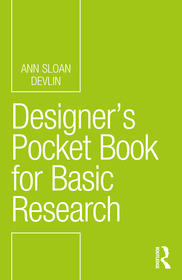
Designer’s Pocket Book for Basic Research
- Publisher's listprice GBP 27.99
-
12 637 Ft (12 035 Ft + 5% VAT)
The price is estimated because at the time of ordering we do not know what conversion rates will apply to HUF / product currency when the book arrives. In case HUF is weaker, the price increases slightly, in case HUF is stronger, the price goes lower slightly.
- Discount 20% (cc. 2 527 Ft off)
- Discounted price 10 109 Ft (9 628 Ft + 5% VAT)
- Discount is valid until: 30 June 2026
Subcribe now and take benefit of a favourable price.
Subscribe
11 373 Ft

Availability
Not yet published.
Why don't you give exact delivery time?
Delivery time is estimated on our previous experiences. We give estimations only, because we order from outside Hungary, and the delivery time mainly depends on how quickly the publisher supplies the book. Faster or slower deliveries both happen, but we do our best to supply as quickly as possible.
Product details:
- Edition number 1
- Publisher Routledge
- Date of Publication 19 August 2026
- ISBN 9781041251842
- Binding Paperback
- No. of pages214 pages
- Size 198x129 mm
- Language English
- Illustrations 32 Illustrations, black & white; 21 Halftones, black & white; 11 Line drawings, black & white; 4 Tables, black & white 700
Categories
Short description:
Designers of the built environment too often complete projects and swiftly shift their attention to the next undertaking, without formally assessing the strengths and shortcomings of their just-completed design.This research is key to improving human wellbeing.
MoreLong description:
Designers of the built environment too often complete projects and swiftly shift their attention to the next undertaking, without formally assessing the strengths and shortcomings of their just-completed design through research.
This research is key to improving human well-being. Sound and useful research need not be expensive nor time-intensive; much can be learned by simply knowing what questions to ask and how to avoid common mistakes. This book provides basic principles of social science research for design and simple tools to execute research projects. Readers will come away from the book familiar with research approaches (correlational, experimental, qualitative), simple statistical tests (t-test, ANOVA, correlation, chi square), standard surveys (e.g., scales for such constructs as privacy and situational awareness) and where to find them, simple software tools that are available to gather, what ethical principles should be followed in using human participants, and when formal IRB (Institutional Review Board) evaluation is required. While not every designer will undertake independent research, even simply reading the literature necessitates knowing the basics.
This book will equip you with the tools to examine and more easily comprehend social science research literature. This will be a helpful resource for professionals in architecture, interior design, environmental design, landscape architecture, and urban planning, particularly those in small firms with limited research budgets, as well as for students.
MoreTable of Contents:
1. The Benefits of Research in Practice: The Synergistic Relationship between Design and Social Science 2. Formulating Research Questions: Looking Back and Looking Ahead 3. Reading the Literature: Locating, Obtaining, and Evaluating Sources 4. Using Human Participants in Research: Guidelines and Best Practices 5. Measuring Outcomes: Asking Questions, Using Scales 6. Methodological Approaches: An Overview 7. Correlational Approaches: The Usefulness of Associations 8. Experimental and Quasi-experimental Designs: Determining Causality 9. Qualitative Strategies: The Benefits of Narrative-based Approaches, Observation and Archival Research 10. Software Tools for Data Collection 11. Software Tools for Data Analysis 12. Reaching an Audience: Sharing Your Findings
More
