

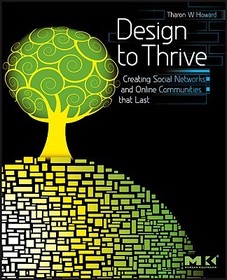
Design to Thrive
Creating Social Networks and Online Communities that Last
- Publisher's listprice EUR 37.95
-
14 823 Ft (14 117 Ft + 5% VAT)
The price is estimated because at the time of ordering we do not know what conversion rates will apply to HUF / product currency when the book arrives. In case HUF is weaker, the price increases slightly, in case HUF is stronger, the price goes lower slightly.
- Discount 10% (cc. 1 482 Ft off)
- Discounted price 13 341 Ft (12 705 Ft + 5% VAT)
Subcribe now and take benefit of a favourable price.
Subscribe
14 823 Ft

Availability
printed on demand
Why don't you give exact delivery time?
Delivery time is estimated on our previous experiences. We give estimations only, because we order from outside Hungary, and the delivery time mainly depends on how quickly the publisher supplies the book. Faster or slower deliveries both happen, but we do our best to supply as quickly as possible.
Product details:
- Publisher Elsevier Science
- Date of Publication 22 February 2010
- ISBN 9780123749215
- Binding Paperback
- No. of pages248 pages
- Size 234x190 mm
- Weight 610 g
- Language English 0
Categories
Long description:
"Social networks and online communities are reshaping the way people communicate, both in their personal and professional lives. What makes some succeed and others fail? What draws a user in? What makes them join? What keeps them coming back? Entrepreneurs and businesses are turning to user experience practitioners to figure this out. Though they are well-equipped to evaluate and create a variety of interfaces, social networks require a different set of design principles and ways of thinking about the user in order to be successful. Design to Thrive presents tried and tested design methodologies, based on the author's decades of research, to ensure successful and sustainable online communities -- whether a wiki for employees to share procedures and best practices or for the next Facebook. The book describes four criteria, called ""RIBS,"" which are necessary to the design of a successful and sustainable online community. These concepts provide designers with the tools they need to generate informed creative and productive design ideas, to think proactively about the communities they are building or maintaining, and to design communities that encourage users to actively contribute."
MoreTable of Contents:
"1. IntroductionI. Why are virtual communities and social networks so popular?II. History of virtual communities (spans 30 years -- what is fad and what is not)III. Business justification for implementing virtual communitiesIV. Differences between ""adhocracy,- a ""forum,- a ""group,- a ""virtual team,- a ""social network,- and a ""virtual community-? People are often sloppy with their use of these terms, which creates problems for designers. 2. What are the factors needed for sustainable online communities?I. What is a ""heuristic- and why do we need one?II. RIBS theory/process3. RemunerationI. What is ""remuneration-?II. Case studies / popular examples?III. What are some best practice strategies for ensuring remuneration is functioning?4. InfluenceI. What is ""influence-?II. Case studies / popular examples?III. Best practice strategies for ensuring influence is functioning?5. BelongingI. What is ""belonging-?II. Case studies / popular examples?III. Best practice strategies for ensuring remuneration is functioning?6. SignificanceI. What is ""significance-?II. Case studies / popular examples?III. Best practice strategies for ensuring significance is functioning?7. ConclusionI. Summative discussion - lessons learned and how to apply them to designers' workII. How RIBS can be used to think about designing for emerging media and delivery systems-particularly those involving mobile computing and videoIII. RIBS' potential for the future of virtual community and social interface design"
More
