

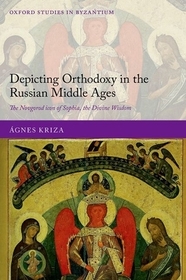
Depicting Orthodoxy in the Russian Middle Ages
The Novgorod Icon of Sophia, the Divine Wisdom
Series: Oxford Studies in Byzantium;
- Publisher's listprice GBP 122.50
-
55 308 Ft (52 675 Ft + 5% VAT)
The price is estimated because at the time of ordering we do not know what conversion rates will apply to HUF / product currency when the book arrives. In case HUF is weaker, the price increases slightly, in case HUF is stronger, the price goes lower slightly.
- Discount 10% (cc. 5 531 Ft off)
- Discounted price 49 778 Ft (47 408 Ft + 5% VAT)
Subcribe now and take benefit of a favourable price.
Subscribe
55 308 Ft

Availability
printed on demand
Why don't you give exact delivery time?
Delivery time is estimated on our previous experiences. We give estimations only, because we order from outside Hungary, and the delivery time mainly depends on how quickly the publisher supplies the book. Faster or slower deliveries both happen, but we do our best to supply as quickly as possible.
Product details:
- Publisher OUP Oxford
- Date of Publication 28 April 2022
- ISBN 9780198854302
- Binding Hardback
- No. of pages386 pages
- Size 240x162x24 mm
- Weight 788 g
- Language English
- Illustrations 105 colour figures 199
Categories
Short description:
This volume offers an interpretation of the image of Divine Wisdom, traditionally associated with the Sophia Cathedral in Novgorod. Kriza argues that the figure stands for the Orthodox Church, in response to events in the fifteenth century.
MoreLong description:
The image of Divine Wisdom, traditionally associated with the Sophia Cathedral in Novgorod, is an innovation of the fifteenth century. The icon represents the winged, royal, red-faced Sophia flanked by the Mother of God and John the Baptist. Although the image has a contemporaneous commentary, and although it exercised a profound influence on Russian cultural history, its meaning, together with the dating and localisation of the first appearance of the iconography, has remained an art-historical conundrum. By exploring the message, roots, function, and historical context of the creation of the first, most emblematic and enigmatic Russian allegorical iconography, Depicting Orthodoxy in the Russian Middle Ages deciphers the meaning of this icon. In contrast to previous interpretations, Kriza argues that the winged Sophia is the personification of the Orthodox Church. The Novgorod Wisdom icon represents the Church of Hagia Sophia, that is, Orthodoxy, as it was perceived in fifteenth-century Rus. Depicting Orthodoxy asserts that the icon, together with its commentary, was a visual-textual response to the Union of Florence between the Catholic and Orthodox Churches, signed in 1439 but rejected by the Russians in 1441. This interpretation is based on detailed interdisciplinary research, drawing on philology, art history, theology, and history. Kriza's study challenges some key assumptions concerning the relevance of Church Schism of 1054, the polemics between the Greeks and the Latins about the bread of Eucharist, and the role of the Union of Florence in the history of Russian art. In particular, by studying both well- and lesser-known works of art alongside overlooked textual evidence, this volume investigates how the Christian Church and its true faith were defined and visualized in Rus and Byzantium throughout the centuries.
This book underscores the value of engaging with textual and visual sources in historical analyses and highlights the innovative output in local contexts relative to competing traditions in the late Middle Ages. Beautifully produced and richly illustrated with color images throughout, this book brings attention to the history and culture of a part of the world that remains to be thoroughly explored-that is Eastern Europe and the Slavia Orthodoxa-while offering a model for how other perplexing iconographies could be deciphered, localized, and contextualized with the help of interdisciplinary perspectives.
Table of Contents:
Introduction
PART I. WORD
The Icon and its Commentary
The Winged Bride: Quotations in the Sophia Commentary
Medieval Russian Sophiology: The Context of the Sophia Commentary in the Manuscripts
PART II. IMAGE
Representations of Wisdom in Rus
The Novgorod Sophia as a Deesis
Sophia in the Womb of the Virgin
PART III. IDENTITY
Slavonic Sophia Churches and the Schism of 1054
Leaven and Byzantine Marian iconography
Depicting Orthodoxy in Rus
PART IV. HISTORY
Sophia, the Divine Wisdom and the Union of Florence
Evfimii II, Archbishop of Novgorod
The Hagia Sophia in Rome
Conclusions
Appendices:
Critical Edition of the Sophia Commentary with English Translation
Table 1: The 'Sophiological Block'
Table 2: The 'Sophiological Synthesis'
Catalogue: The Iconography of the Novgorod Sophia in the Fifteenth and Sixteenth Centuries

