

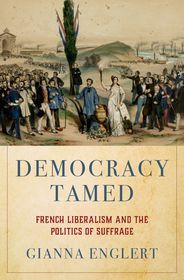
Democracy Tamed
French Liberalism and the Politics of Suffrage
- Publisher's listprice GBP 59.00
-
28 187 Ft (26 845 Ft + 5% VAT)
The price is estimated because at the time of ordering we do not know what conversion rates will apply to HUF / product currency when the book arrives. In case HUF is weaker, the price increases slightly, in case HUF is stronger, the price goes lower slightly.
- Discount 10% (cc. 2 819 Ft off)
- Discounted price 25 369 Ft (24 161 Ft + 5% VAT)
Subcribe now and take benefit of a favourable price.
Subscribe
28 187 Ft

Availability
Estimated delivery time: In stock at the publisher, but not at Prospero's office. Delivery time approx. 3-5 weeks.
Not in stock at Prospero.
Why don't you give exact delivery time?
Delivery time is estimated on our previous experiences. We give estimations only, because we order from outside Hungary, and the delivery time mainly depends on how quickly the publisher supplies the book. Faster or slower deliveries both happen, but we do our best to supply as quickly as possible.
Product details:
- Publisher OUP USA
- Date of Publication 29 August 2024
- ISBN 9780197635315
- Binding Hardback
- No. of pages224 pages
- Size 229x150x22 mm
- Weight 476 g
- Language English 541
Categories
Short description:
Liberal democracies are under constant threat in the twenty-first century, and there is growing scepticism about whether liberalism and democracy can continue to survive together. In Democracy Tamed, Gianna Englert argues that the dilemmas facing liberal democracy are not unique to our present moment, but have existed since the birth of liberal political thought in nineteenth-century France. Combining political theory and intellectual history, Democracy Tamed tells the story of how the earliest liberals deployed their "new democracy" to combat universal suffrage. But it also reveals how later liberals would appropriate their predecessors' antidemocratic arguments to safeguard liberal democracies as we have come to know them.
MoreLong description:
Does good democratic government require intelligent, moral, and productive citizens? Can our political institutions educate the kind of citizens we wish or need to have? With recent arguments "against democracy" and fears about the rise of populism, there is growing scepticism about whether liberalism and democracy can continue to survive together. Some even question whether democracy is worth saving.
In Democracy Tamed, Gianna Englert argues that the dilemmas facing liberal democracy are not unique to our present moment, but have existed since the birth of liberal political thought in nineteenth-century France. Combining political theory and intellectual history, Englert shows how nineteenth-century French liberals championed the idea of "political capacity" as an alternative to democratic political rights and argued that voting rights should be limited to capable citizens who would preserve free, stable institutions against revolutionary passions and democratic demands. Liberals also redefined democracy itself, from its ancient meaning as political rule by the people to something that, counterintuitively, demanded the guidance of a capable few rather than the rule of all.
Understandably, scholarly treatments of political capacity have criticized the idea as exclusionary and potentially dangerous. Englert argues instead that political capacity was a flexible standard that developed alongside a changing society and economy, allowing liberals to embrace democracy without abandoning their first principles. She reveals a forgotten, uncharted path of liberalism in France that remained open to political democracy while aiming to foster citizen capacity. Overall, Democracy Tamed tells the story of how the earliest liberals deployed their notion of the "new democracy" to resist universal suffrage. But it also reveals how later liberals would appropriate their predecessors' antidemocratic arguments to safeguard liberal democracies as we have come to know them.
Gianna Englert's original and well-researched book invites her readers to reflect on the complex history of liberalism and the challenges to political democracy. She examines the language of political capacity in the writings of nineteenth-century political thinkers such as Guizot, Constant, Tocqueville, Laboulaye, and Duvergier de Hauranne, who teach us important lessons about the complex relationship between liberalism and democracy. An essential book for political theorists, historians of political thought, and intellectual historians.
Table of Contents:
Introduction
1."Representation With Real Force": Benjamin Constant and the Direct Vote
2. François Guizot and Democracy's "Capable" Aristocracy
3. Tocqueville's Other Democracy: On the Franchise in America and France
4. Édouard Laboulaye's Enlightened Democracy
5. "The Regular Representation of Opinion": Duvergier de Hauranne and Political Parties
Conclusion
Notes
References
Index

