

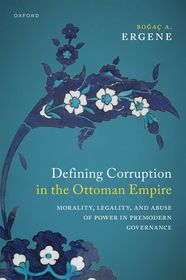
Defining Corruption in the Ottoman Empire
Morality, Legality, and Abuse of Power in Premodern Governance
- Publisher's listprice GBP 108.00
-
51 597 Ft (49 140 Ft + 5% VAT)
The price is estimated because at the time of ordering we do not know what conversion rates will apply to HUF / product currency when the book arrives. In case HUF is weaker, the price increases slightly, in case HUF is stronger, the price goes lower slightly.
- Discount 10% (cc. 5 160 Ft off)
- Discounted price 46 437 Ft (44 226 Ft + 5% VAT)
Subcribe now and take benefit of a favourable price.
Subscribe
51 597 Ft

Availability
Estimated delivery time: In stock at the publisher, but not at Prospero's office. Delivery time approx. 3-5 weeks.
Not in stock at Prospero.
Why don't you give exact delivery time?
Delivery time is estimated on our previous experiences. We give estimations only, because we order from outside Hungary, and the delivery time mainly depends on how quickly the publisher supplies the book. Faster or slower deliveries both happen, but we do our best to supply as quickly as possible.
Product details:
- Publisher OUP Oxford
- Date of Publication 9 May 2024
- ISBN 9780198916215
- Binding Hardback
- No. of pages352 pages
- Size 240x165x25 mm
- Weight 694 g
- Language English
- Illustrations 4 figures and 16 tables 510
Categories
Short description:
This book explores how premodern Ottomans characterised public office corruption and what specific transgressions they associated with this notion before the nineteenth century. It identifies articulations of self-interested abuses of power in this context and illustrates how they resonate in some ways with modern perspectives.
MoreLong description:
How did the premodern Ottomans understand public office corruption? To answer this question, Defining Corruption in the Ottoman Empire explores how Ottoman jurists, statesmen, political commentators, and others characterized this notion and what specific transgressions they associated with it before the nineteenth century. The book is based on extensive research and a wide variety of sources, including jurisprudential texts, imperial orders and communications, chronicles, and travel and diplomatic accounts. It identifies articulations of self-interested abuses of power by official and communal actors in these sources and illustrates how they resonate in some ways with modern perspectives. These premodern formulations, however, are shown to have collectively constituted a conceptual space that was contentious and temporally unstable, and no single overarching term was able to encapsulate all the specific misdeeds frequently linked to modern depictions of corruption.
The book's genre-specific discursive survey is complemented by discussions that highlight, in the Ottoman context, the shifty boundaries that separated legitimate and illegitimate forms of revenue extraction; that examine the state's efforts to monitor and punish abuses by government officials; and that explore the context-dependent and often contested moralities of many acts, such as gift giving as bribery, office selling, and favoritism. It also considers the ways in which "corrupt" state actors might have rationalized their offenses.
Defining Corruption is a conceptually driven work that is both comparative and interdisciplinary, engaging seriously with non-Ottoman historiographies, including broader Middle Eastern, European, and Chinese, and multiple disciplines besides history, in particular anthropology and economics, to provide a comprehensive analysis of premodern Ottoman perceptions of administrative abuse.
With its well-researched analysis and critical engagement with historiographical debates, this book makes a significant contribution not only to Ottoman history but also to broader discussions on corruption, legalhistory, and governance in pre-modern societies.
Table of Contents:
Glossary
A Note on Transliteration
Introduction Conceptual Reflections
Corruption Based on Pre-Ottoman Jurisprudential Sources
Corruption in Ottoman Jurisprudence
Abuse and Predation in State Documents
Controlling Corruption
Corruption in Ottoman Political Literature
Corruption According to Accounts for Foreigners
Gifts as Bribes
On the Morality of Patronage: The Case of Ilmiye
Conclusion: Possible Rationalizations of Corruption and Other Afterthoughts
References
Index

