

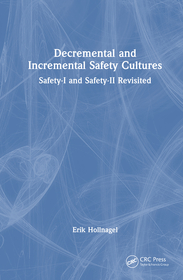
Decremental and Incremental Safety Cultures
Safety-I and Safety-II Revisited
-
GET 10% OFF
- Publisher's listprice GBP 86.99
-
41 559 Ft (39 580 Ft + 5% VAT)
The price is estimated because at the time of ordering we do not know what conversion rates will apply to HUF / product currency when the book arrives. In case HUF is weaker, the price increases slightly, in case HUF is stronger, the price goes lower slightly.
- Discount 10% (cc. 4 156 Ft off)
- Discounted price 37 403 Ft (35 622 Ft + 5% VAT)
37 403 Ft

Availability
Not yet published.
Why don't you give exact delivery time?
Delivery time is estimated on our previous experiences. We give estimations only, because we order from outside Hungary, and the delivery time mainly depends on how quickly the publisher supplies the book. Faster or slower deliveries both happen, but we do our best to supply as quickly as possible.
Product details:
- Edition number 1
- Publisher CRC Press
- Date of Publication 17 June 2026
- ISBN 9781041065999
- Binding Hardback
- No. of pages264 pages
- Size 234x156 mm
- Language English
- Illustrations 34 Illustrations, black & white; 34 Line drawings, black & white 700
Categories
Short description:
This book is an ideal read for professionals in the fields of occupational health and safety, human factors and risk management. If you have read Safety-I and Safety-II (CRC Press, 9781472423085) by the same author, this book is a must-have to understand the next phase of the Safety-I and Safety-II concepts.
MoreLong description:
Safety is a concept as complex as it is crucial. In this new book, Erik Hollnagel reimagines how we approach, understand, and manage safety in modern contexts. It challenges traditional perspectives while weaving together historical insights, cultural analysis, and practical guidance to offer a richer understanding of what it means to work and live safely.
Decremental and Incremental Safety Cultures: Safety-I and Safety-II Revisited goes beyond identifying and analyzing safety issues to offer practicable strategies that balance protection and productivity. From the ambivalence of safety and the dialectics of outcomes to the seven stages of safety thinking, each chapter highlights a key aspect of safety practices. It introduces new frameworks including the deconstruction of everyday work and safety solutionism, offering readers the tools to critically assess their own safety measures and form better outcomes. Written in clear, jargon-free language, the book ensures that these insights are accessible to everyone, regardless of their background or experience and readers will develop a decremental and incremental safety.
This book is an ideal read for professionals in the fields of occupational health and safety, human factors and risk management. If you have read Safety-I and Safety-II (CRC Press, 9781472423085) by the same author, this book is a must-have to understand the next phase of the Safety-I and Safety-II concepts.
- Delivers a completely novel, yet practical, approach to safety problems, tied to Safety-I and Safety-II principles
- Identifies and analyzes key problems, but also proposes practical solutions applicable to any safety scenario
- Reviews the necessary in-depth historical and cultural background for understanding safety and managing safely, showing leadership qualities
- Features a commentary for each chapter underlining the safety learning points for the reader to take away
- Presents the ideas in a non-academic style and with intentionally jargon-fee language, making this title an everyman purchase
Table of Contents:
1. A primer of Safety-I & Safety-II. 2. The apparent ambiguity of safety. 3. The seven biases of safety thinking. 4. The Inevitability of Accidents. 5. The semantic non-sense of safety. 6.The seven stages of safety thinking. 7. Atomistic accident thinking. 8. The Complexity Delusion. 9. Safety pragmatism. 10. Safety solutionism. 11. Improving the ratio of acceptable to unacceptable outcomes. 12. Decremental safety practices. 13. Incremental safety practices. 14. The Resilient Performance Enhancement Toolkit (RPET).
More
