

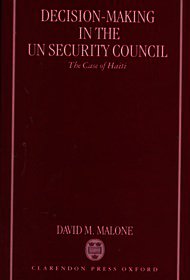
Decision-Making in the UN Security Council
The Case of Haiti, 1990-1997
- Publisher's listprice GBP 43.99
-
19 861 Ft (18 915 Ft + 5% VAT)
The price is estimated because at the time of ordering we do not know what conversion rates will apply to HUF / product currency when the book arrives. In case HUF is weaker, the price increases slightly, in case HUF is stronger, the price goes lower slightly.
- Discount 10% (cc. 1 986 Ft off)
- Discounted price 17 875 Ft (17 024 Ft + 5% VAT)
Subcribe now and take benefit of a favourable price.
Subscribe
19 861 Ft

Availability
printed on demand
Why don't you give exact delivery time?
Delivery time is estimated on our previous experiences. We give estimations only, because we order from outside Hungary, and the delivery time mainly depends on how quickly the publisher supplies the book. Faster or slower deliveries both happen, but we do our best to supply as quickly as possible.
Product details:
- Publisher OUP Oxford
- Date of Publication 5 November 1998
- ISBN 9780198294832
- Binding Hardback
- No. of pages356 pages
- Size 243x162x23 mm
- Weight 646 g
- Language English 0
Categories
Short description:
This unique and intriguing study examines the UN's efforts to reinstate Haitian President Aristide, overthrown in a 1991 coup. An active participant in some of the dramatic events in Haiti, David Malone sheds new light on the roles and motivations of key actors, particularly the US; the Security Council authorized use of force; issues of power and influence at the UN; the links between the Haiti crisis and other contemporary international conflicts; and UN co-operation with the Organization of American States.
MoreLong description:
After President Aristide was overthrown by the Haitian military in September 1991, the UN Security Council and the OAS instituted a progression of measures to restore him to power. This unique and intriguing study examines how and why the UN Security Council took its decisions on Haiti, including authorization in July 1994 of the use of force by a US-led multinational coalition against the de facto regime.
After outlining key trends in the Council's work from 1990-97 and providing a sketch of Haiti's history, the author reviews the milestones in the Haitian crisis, focusing principally on their international dimension but also discussing Haitian domestic factors which influenced the crisis. Drawing on an unprecedented range of UN and OAS documents, media reports and original interviews, Malone explores how and why the Haiti case found its way on to the Security Council's agenda, probes the motivations and roles of key actors, examines the Security Council as an institutional framework for action, and asseses the success of Security Council strategies on Haiti. The study touches on issues of power and influence within the UN Security Council, the links between the Security Council's decisions on Haiti and its reactions to other, recent, international crises, UN cooperation with the OAS, and the factors shaping national positions in the Security Council, with a particular focus on the impact of US domestic events.
'accessible and of great value.'
Table of Contents:
Foreword by Adam Roberts
Introduction
Rise and Decline of Security Council Activism, 1990-97
An Overview of Haiti's History
The Anti-Aristide Coup and the International Response, January 1991-November 1992
The Governors Island Agreement, December 1992-November 1993
Authorization for the Use of Force and Aristide's Return, November 1993-October 1994
Stabilization and Peacebuilding, October 1994-December 1997
Conclusions
Chronology

