

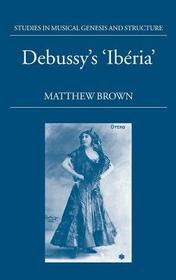
Debussy's 'Ibéria'
Series: Studies in Musical Genesis, Structure & Interpretation;
- Publisher's listprice GBP 172.50
-
77 883 Ft (74 175 Ft + 5% VAT)
The price is estimated because at the time of ordering we do not know what conversion rates will apply to HUF / product currency when the book arrives. In case HUF is weaker, the price increases slightly, in case HUF is stronger, the price goes lower slightly.
- Discount 10% (cc. 7 788 Ft off)
- Discounted price 70 095 Ft (66 758 Ft + 5% VAT)
Subcribe now and take benefit of a favourable price.
Subscribe
77 883 Ft

Availability
printed on demand
Why don't you give exact delivery time?
Delivery time is estimated on our previous experiences. We give estimations only, because we order from outside Hungary, and the delivery time mainly depends on how quickly the publisher supplies the book. Faster or slower deliveries both happen, but we do our best to supply as quickly as possible.
Product details:
- Publisher OUP Oxford
- Date of Publication 2 October 2003
- ISBN 9780198161998
- Binding Hardback
- No. of pages194 pages
- Size 237x156x10 mm
- Weight 426 g
- Language English
- Illustrations numerous music examples and figures 0
Categories
Short description:
Matthew Brown examines Debussy's sketches and drafts to show how the composer wrote one of his last great symphonic scores: Ibéria (from Images for orchestra). He describes the work's compositional history, the various intentional goals and historical contraints that guided Debussy's thinking, and some of the technical problems Debussy faced while composing this remarkable score.
MoreLong description:
For well over a century musicologists have been fascinated by composers' manuscripts and by the insights they might reveal about the nature of musical composition. This book suggests ways in which Debussy's sketches and drafts may be used to explain how he composed one of his last great symphonic scores: Ibéria (from Images for orchestra, 1903-10). Part 1 shows how we might understand the process of musical composition as a form of expert problem solving; it describes the compositional history of the work, the various intentional goals and historical constraints that guided Debussy's thinking, and some of the technical problems Debussy faced while composing this remarkable score. Part 2 reconstructs the genesis of each of the three movements in turn.
Brown's insights into Iberia prove highly illuminating; his book is lucidly written and extremely generous with examples and documentation. It helps to have a score at hand , but even the most involved parts of the analysis flow easily, and one need not be either a specialist in Schenker or sketch studies to follow it.
Table of Contents:
Editor's Preface
Preface
Musical Composition and Problem Solving
Composition History and Musical Sources
Intentional Goals and Historical Constraints
Musical Problems and Search Strategies
'Par les rues e les chemins'
'Les Parfums de la nuit'
'Le Matin d'un jour de fête'
Sketch Studies and Musical Analysis
Bibliography
Index

