

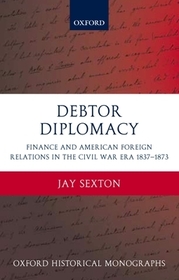
Debtor Diplomacy
Finance and American Foreign Relations in the Civil War Era 1837-1873
Series: Oxford Historical Monographs;
- Publisher's listprice GBP 187.50
-
84 656 Ft (80 625 Ft + 5% VAT)
The price is estimated because at the time of ordering we do not know what conversion rates will apply to HUF / product currency when the book arrives. In case HUF is weaker, the price increases slightly, in case HUF is stronger, the price goes lower slightly.
- Discount 10% (cc. 8 466 Ft off)
- Discounted price 76 191 Ft (72 563 Ft + 5% VAT)
Subcribe now and take benefit of a favourable price.
Subscribe
84 656 Ft

Availability
printed on demand
Why don't you give exact delivery time?
Delivery time is estimated on our previous experiences. We give estimations only, because we order from outside Hungary, and the delivery time mainly depends on how quickly the publisher supplies the book. Faster or slower deliveries both happen, but we do our best to supply as quickly as possible.
Product details:
- Publisher OUP Oxford
- Date of Publication 21 July 2005
- ISBN 9780199281039
- Binding Hardback
- No. of pages300 pages
- Size 224x145x22 mm
- Weight 452 g
- Language English
- Illustrations numerous graphs, 2 tables 0
Categories
Short description:
The United States was a debtor nation in the mid-nineteenth century, with half of its debt held overseas. The need to obtain foreign capital greatly influenced American foreign policy, principally relations with Britain. The intersection of finance and diplomacy was particularly evident during the Civil War when both the North and South integrated attempts to procure loans from European banks into their larger international strategies. Drawing on the unused archives of London banks and the papers of statesmen on both sides of the Atlantic, this work explores a central theme of mid-nineteenth-century foreign relations and a crucial, but previously ignored, aspect of the Civil War.
MoreLong description:
The United States was a debtor nation in the mid-nineteenth century, with half of its national debt held overseas. Lacking the resources to develop the nation and to fund the wars necessary to expand and then preserve it, the United States looked across the Atlantic for investment capital. The need to obtain foreign capital greatly influenced American foreign policy, principally relations with Britain. The intersection of finance and diplomacy was particularly evident during the Civil War when both the North and South integrated attempts to procure loans from European banks into their larger international strategies. Furthermore, the financial needs of the United States (and the Confederacy) imparted significant political power to an elite group of London-based financiers who became intimately involved in American foreign relations during this period. This study explores and assesses how the United State's need for capital influenced its foreign relations in the tumultuous years wedged between the two great financial crises of the nineteenth century, 1837 to 1873.
Drawing on the unused archives of London banks and the papers of statesmen on both sides of the Atlantic, this work illuminates our understanding of mid-nineteenth-century American foreign relations by highlighting how financial considerations influenced the formation of foreign policy and functioned as a peace factor in Anglo-American relations. This study also analyses a crucial, but ignored, dimension of the Civil War - the efforts of both the North and the South to attract the support of European financiers. Though foreign contributions to each side failed to match the hopes of Union and Confederate leaders, the financial diplomacy of the Civil War shaped the larger foreign policy strategies of both sides and contributed to both the preservation of British neutrality and the ultimate defeat of the Confederacy.
Sexton's analysis demonstrates that he spent a great deal of time reading and analysing primary source documets from the period
Table of Contents:
Introduction: Finance and Foreign Relations in the Mid-Nineteenth Century
The Baring Years, 1837-1861
Union Finance and Diplomacy
Confederate Finance and Diplomacy
'Were it not for our Debt,' 1865-73
Conclusion
Bibliography

