

- Publisher's listprice GBP 22.49
-
10 154 Ft (9 670 Ft + 5% VAT)
The price is estimated because at the time of ordering we do not know what conversion rates will apply to HUF / product currency when the book arrives. In case HUF is weaker, the price increases slightly, in case HUF is stronger, the price goes lower slightly.
- Discount 10% (cc. 1 015 Ft off)
- Discounted price 9 138 Ft (8 703 Ft + 5% VAT)
Subcribe now and take benefit of a favourable price.
Subscribe
10 154 Ft

Availability
printed on demand
Why don't you give exact delivery time?
Delivery time is estimated on our previous experiences. We give estimations only, because we order from outside Hungary, and the delivery time mainly depends on how quickly the publisher supplies the book. Faster or slower deliveries both happen, but we do our best to supply as quickly as possible.
Product details:
- Publisher OUP USA
- Date of Publication 16 November 2017
- ISBN 9780190202910
- Binding Paperback
- No. of pages288 pages
- Size 208x137x17 mm
- Weight 340 g
- Language English 0
Categories
Short description:
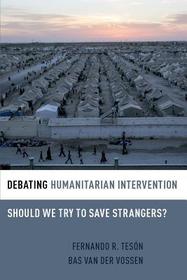
Philosophers Fernando Tesón and Bas van der Vossen offer contrasting views of humanitarian intervention: as a war aimed at ending tyranny, or as unjustifiable violence. Fernando Tesón argues that humanitarian interventions are sometimes permissible; Bas van der Vossen argues that as a rule they are not. The authors use the tools of modern analytic philosophy, in particular just war theory, to substantiate their claims.
MoreLong description:
When foreign powers attack civilians, other countries face an impossible dilemma. Two courses of action emerge: either to retaliate against an abusive government on behalf of its victims, or to remain spectators. Either course offers its own perils: the former, lost lives and resources without certainty of restoring peace or preventing worse problems from proliferating; the latter, cold spectatorship that leaves a country at the mercy of corrupt rulers or to revolution.
Philosophers Fernando Tesón and Bas van der Vossen offer contrasting views of humanitarian intervention, defining it as either war aimed at ending tyranny, or as violence. The authors employ the tools of impartial modern analytic philosophy, particularly just war theory, to substantiate their claims. According to Tesón, a humanitarian intervention has the same just cause as a justified revolution: ending tyranny. He analyzes the different kinds of just cause and whether or not an intervener may pursue other justified causes. For Tesón, the permissibility of humanitarian intervention is almost exclusively determined by the rules of proportionality. Bas van der Vossen, by contrast, holds that military intervention is morally impermissible in almost all cases. Justified interventions, Van der Vossen argues, must have high ex ante chance of success. Analyzing the history and prospects of intervention shows that they almost never do.
Tesón and van der Vossen refer to concrete cases, and weigh the consequences of continued or future intervention in Syria, Somalia, Rwanda, Bosnia, Iraq, Lybia and Egypt. By placing two philosophers in dialogue, Debating Humanitarian Intervention is not constrained by a single, unifying solution to the exclusion of all others. Rather, it considers many conceivable actions as judged by analytic philosophy, leaving the reader equipped to make her own, informed judgments.
the book is an excellent contribution in terms of bringing together different arguments on intervention, the moral dilemma involved and the implicit political logic...the book...presents a much more condensed and balanced overview. It would be of great help to students and researchers working on issues pertaining to sovereignty, international justice, intervention and non-intervention to find multiple sources in a single book.
Table of Contents:
Introduction
Fernando Tesón and Bas van der Vossen
Part I: A defense of humanitarian intervention Fernando Tesón
1. Humanitarian intervention as defense of persons
2. Just cause in humanitarian intervention
3. Intervention and revolution: the equivalence thesis
4. Proportionality in humanitarian intervention
5. Further issues in humanitarian intervention
APPENDIX: The Iraq war
Part II: Humanitarian non-intervention Bas van der Vossen
6. A presumption against intervention
7. Between internal and external threats
8. Why sovereignty (still) matters
9. The success condition
10. Justice ex post or ex ante?
11. Three structural problems
12. Looking for exceptions
13. Humanitarian non-intervention

