

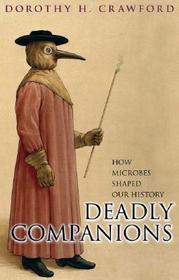
Deadly Companions
How microbes shaped our history
- Publisher's listprice GBP 16.99
-
7 670 Ft (7 305 Ft + 5% VAT)
The price is estimated because at the time of ordering we do not know what conversion rates will apply to HUF / product currency when the book arrives. In case HUF is weaker, the price increases slightly, in case HUF is stronger, the price goes lower slightly.
- Discount 10% (cc. 767 Ft off)
- Discounted price 6 903 Ft (6 575 Ft + 5% VAT)
Subcribe now and take benefit of a favourable price.
Subscribe
7 670 Ft

Availability
Uncertain availability. Please turn to our customer service.
Why don't you give exact delivery time?
Delivery time is estimated on our previous experiences. We give estimations only, because we order from outside Hungary, and the delivery time mainly depends on how quickly the publisher supplies the book. Faster or slower deliveries both happen, but we do our best to supply as quickly as possible.
Product details:
- Publisher OUP Oxford
- Date of Publication 25 October 2007
- ISBN 9780192807199
- Binding Hardback
- No. of pages272 pages
- Size 222x145x27 mm
- Weight 458 g
- Language English
- Illustrations 25 black and white line drawings and halftones 0
Categories
Short description:
The story of human history has been inextricably entwined with the story of microbes. Combining tales of devastating epidemics with accessible science and fascinating history, Deadly Companions reveals how closely microbes have evolved with us over the millennia, shaping human culture through infection, disease, and deadly pandemic.
MoreLong description:
Ever since we started huddling together in communities, the story of human history has been inextricably entwined with the story of microbes. They have evolved and spread amongst us, shaping our culture through infection, disease, and pandemic. At the same time, our changing human culture has itself influenced the evolutionary path of microbes. Dorothy H. Crawford here shows that one cannot be truly understood without the other.
Beginning with a dramatic account of the SARS pandemic at the start of the 21st century, she takes us back in time to follow the interlinked history of microbes and man, taking an up-to-date look at ancient plagues and epidemics, and identifying key changes in the way humans have lived - such as our move from hunter-gatherer to farmer to city-dweller - which made us vulnerable to microbe attack.
Showing how we live our lives today - with increasing crowding and air travel - puts us once again at risk, Crawford asks whether we might ever conquer microbes completely, or whether we need to take a more microbe-centric view of the world. Among the possible answers, one thing becomes clear: that for generations to come, our deadly companions will continue to shape human history.
Lucid and authoritative... crisply written narrative.
Table of Contents:
Preface
Introduction
How it all began
Microbes and our hunter gatherer ancestors
Microbes exploit the sedentary lifestyle
Microbes, crowds and poverty
Microbes go global
Microbes, famine and starvation
Science intervenes
Current problems
Conclusions
Glossary
Index

