

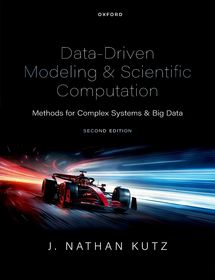
Data-Driven Modeling & Scientific Computation
Methods for Complex Systems & Big Data
- Publisher's listprice GBP 141.00
-
63 661 Ft (60 630 Ft + 5% VAT)
The price is estimated because at the time of ordering we do not know what conversion rates will apply to HUF / product currency when the book arrives. In case HUF is weaker, the price increases slightly, in case HUF is stronger, the price goes lower slightly.
- Discount 10% (cc. 6 366 Ft off)
- Discounted price 57 295 Ft (54 567 Ft + 5% VAT)
Subcribe now and take benefit of a favourable price.
Subscribe
63 661 Ft

Availability
Not yet published.
Why don't you give exact delivery time?
Delivery time is estimated on our previous experiences. We give estimations only, because we order from outside Hungary, and the delivery time mainly depends on how quickly the publisher supplies the book. Faster or slower deliveries both happen, but we do our best to supply as quickly as possible.
Product details:
- Publisher OUP Oxford
- Date of Publication 21 May 2026
- ISBN 9780198929093
- Binding Hardback
- No. of pages608 pages
- Size 246x189 mm
- Language English
- Illustrations 240 b/w illustrations 700
Categories
Short description:
An accessible introductory to advanced text focusing on integrating scientific computing methods and algorithms with modern data analysis techniques, including basic applications of machine learning in the sciences and engineering.
MoreLong description:
Data-Driven Modeling & Scientific Computation: Methods for Complex Systems & Big Data is an accessible introductory-to-advanced textbook focusing on integrating scientific computing methods and algorithms with modern data analysis techniques, including basic applications of machine learning in the sciences and engineering. Its overarching goal is to develop techniques that allow for the integration of the dynamics of complex systems and big data.
This comprehensive textbook provides a survey of practical numerical solution techniques for ordinary and partial differential equations as well as algorithms for data manipulation, data-driven modelling, and machine learning. Emphasis is on the implementation of numerical schemes to practical problems in the engineering, biological, and physical sciences.
The high-level programming language python is used throughout the book to implement and develop mathematical solution strategies. One specific aim of the book is to integrate standard scientific computing methods with the burgeoning field of data analysis, machine learning and Artificial Intelligence (AI). This area of research is expanding at an incredible pace in the sciences due to the proliferation of data collection in almost every field of science.
The enormous data sets routinely encountered in the sciences now certainly give a big incentive to develop mathematical techniques and computational algorithms that help synthesize, interpret, and give meaning to the data in the context of its scientific setting. This brings together, in a self-consistent fashion, the key ideas from (i) statistics, (ii) time-frequency analysis and (iii) low-dimensional reductions in order to provide meaningful insight into the data sets one is faced with in any scientific field today, including those generated from complex dynamic systems. This is a tremendously exciting area and much of this part of the book is driven by intuitive examples of how the three areas (i)-(iii) can be used in combination to give critical insight into the fundamental workings of various problems.
Review from previous edition The book allows methods for dealing with large data to be explained in a logical process suitable for both undergraduate and post-graduate students ... With sport performance analysis evolving into deal with big data, the book forms a key bridge between mathematics and sport science
Table of Contents:
Prolegomenon to modern computing
Part 1. Basic computations and visualization
Python introduction
Linear systems
Numerical differentiation and integration
Curve fitting
Basic optimization
Advanced curve fitting and machine learning
Visualization
Part 2. Differential and partial differential equations
Initial and boundary value problems of differential equations
Finite difference methods
Time and space stepping schemes: methods of lines
Spectral methods
Finite element methods
Part 3. Computational methods for data analysis
Statistical methods and their applications
Time-frequency analysis: Fourier transforms and wavelets
Matrix decompositions
Independent component analysis
Unsupervised machine learning
Supervised machine learning
Reinforcement learning
Spatio-temporal data and dynamics
Data assimilation methods
Bibliography
Index

