

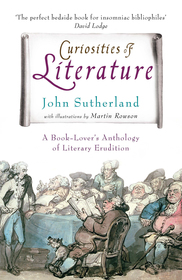
Curiosities of Literature
A Book-lover's Anthology of Literary Erudition
-
GET 20% OFF
- Publisher's listprice GBP 15.99
-
7 219 Ft (6 875 Ft + 5% VAT)
The price is estimated because at the time of ordering we do not know what conversion rates will apply to HUF / product currency when the book arrives. In case HUF is weaker, the price increases slightly, in case HUF is stronger, the price goes lower slightly.
- Discount 20% (cc. 1 444 Ft off)
- Discounted price 5 775 Ft (5 500 Ft + 5% VAT)
- Discount is valid until: 31 August 2026
5 775 Ft

Availability
This item is unavailable in our region due to legal reasons.
Why don't you give exact delivery time?
Delivery time is estimated on our previous experiences. We give estimations only, because we order from outside Hungary, and the delivery time mainly depends on how quickly the publisher supplies the book. Faster or slower deliveries both happen, but we do our best to supply as quickly as possible.
Product details:
- Publisher Random House
- Date of Publication 5 November 2009
- Number of Volumes B-format paperback
- ISBN 9780099519294
- Binding Paperback
- No. of pages304 pages
- Size 198x129x22 mm
- Weight 283 g
- Language English 0
Categories
Long description:
How much heavier was Thackeray's brain than Walt Whitman's? Which novels do American soldiers read? When did cigarettes start making an appearance in English literature? And, while we're about it, who wrote the first Western, is there any link between asthma and literary genius, and what really happened on Dorothea's wedding night in Middlemarch?
In Curiosities of Literature, John Sutherland contemplates the full import of questions such as these, and attempts a few answers in a series of essays that are both witty and eclectic. His approach is also unashamedly discursive. An account of the fast-working Mickey Spillane, for example, leads to a consideration of the substances, both legal and illegal, that authors have employed to boost their creative energies. An essay on good and bad handwriting points out in passing that Thackeray could write the Lord's Prayer on the back of a stamp. As for Mary Shelley, a brief recital of the circumstances in which she wrote Frankenstein stops off to consider what impact the miserable summer weather of 1816 had on the future path of English literature.
Of course, it is debatable whether knowledge of these arcane topics adds to the wisdom of nations, but it does highlight the random pleasures to be found in reading literature and reading about it. As John Sutherland rightly asks, 'Why else read?'

