

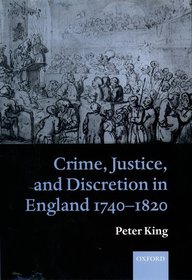
Crime, Justice, and Discretion in England 1740-1820
- Publisher's listprice GBP 197.50
-
89 171 Ft (84 925 Ft + 5% VAT)
The price is estimated because at the time of ordering we do not know what conversion rates will apply to HUF / product currency when the book arrives. In case HUF is weaker, the price increases slightly, in case HUF is stronger, the price goes lower slightly.
- Discount 10% (cc. 8 917 Ft off)
- Discounted price 80 254 Ft (76 433 Ft + 5% VAT)
Subcribe now and take benefit of a favourable price.
Subscribe
89 171 Ft

Availability
printed on demand
Why don't you give exact delivery time?
Delivery time is estimated on our previous experiences. We give estimations only, because we order from outside Hungary, and the delivery time mainly depends on how quickly the publisher supplies the book. Faster or slower deliveries both happen, but we do our best to supply as quickly as possible.
Product details:
- Publisher OUP Oxford
- Date of Publication 28 September 2000
- ISBN 9780198229100
- Binding Hardback
- No. of pages398 pages
- Size 243x163x26 mm
- Weight 727 g
- Language English
- Illustrations graphs and tables, 1 map 0
Categories
Short description:
The criminal law has often been seen as central to the rule of the 18th century landed elite. Within detailed studies of every stage of the criminal process this volume explores key issues such as who used the law, for what purposes, and with what effects. It then challenges the view that the law was primarily the instrument of a small elite, portraying it instead as an arena of struggle, negotiation, and compromise used by many different social groups. The criminal justice system may have somtimes been vulnerable to power but it was also useful in limiting it.
MoreLong description:
The criminal law has often been seen as central to the rule of the 18th century landed elite in England.
This book presents a detailed analysis of the judicial process - of victim's reactions, pretrial practices, policing, magistrates hearings, trials, sentencing, pardoning and punishment - using property offenders as its main focus. The period 1740-1820, the final era before the coming of the new police and the repeal of the capital code, emerges as the great age of discretionary justice, and the book explores the impact of the vast discretionary powers held by many social groups. It reassesses both the relationship betweeen crime rates and economic deprivation, and the many ways that vulnerability to prosecution varied widely across the lifecycle, in the light of the highly selective nature of pretrial negotiations.
More centrally, by asking at every stage who used the law, for what purposes, in whose interests and with what effects, it opens up a number of new perspectives on the role of the law in eighteenth century social relations. The law emerges as the less the instrument of particular elite groups and more as an arena of struggle, of negotiation and of compromise. Its rituals were less controllable and its merciful moments less manageable and less exclusively available to the gentry elite than has been previously suggested. Justice was vulnerable to power but was also mobilised to constrain it. Despite the key functions that the propertied fulfilled, courtroom crowds, the counter-theatre of the condemned and the decisions of the victims from a very wide range of backgrounds had a role to play, and the criteria on which decisions were based were shaped as much by the broad and more humane discourse which Fielding called the "good mind" as by the instrumental needs of the propertied elites.
Crime, Justice, and Discretion in England provides historians with a meticulously executed and revealing study of the functioning of the pre-Peel criminal justice system. King's analysis amply supports his concluding characterization of the system as one not simply of terror and exploitation, but of 'struggle, of negotiation, of accommodation' with practically every social group shaping the system and being shaped by it.

