

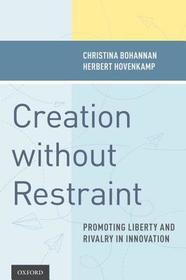
Creation without Restraint
Promoting Liberty and Rivalry in Innovation
- Publisher's listprice GBP 68.00
-
30 702 Ft (29 240 Ft + 5% VAT)
The price is estimated because at the time of ordering we do not know what conversion rates will apply to HUF / product currency when the book arrives. In case HUF is weaker, the price increases slightly, in case HUF is stronger, the price goes lower slightly.
- Discount 10% (cc. 3 070 Ft off)
- Discounted price 27 632 Ft (26 316 Ft + 5% VAT)
Subcribe now and take benefit of a favourable price.
Subscribe
30 702 Ft

Availability
printed on demand
Why don't you give exact delivery time?
Delivery time is estimated on our previous experiences. We give estimations only, because we order from outside Hungary, and the delivery time mainly depends on how quickly the publisher supplies the book. Faster or slower deliveries both happen, but we do our best to supply as quickly as possible.
Product details:
- Publisher OUP USA
- Date of Publication 12 July 2012
- ISBN 9780199738830
- Binding Hardback
- No. of pages440 pages
- Size 163x236x27 mm
- Weight 782 g
- Language English 0
Categories
Short description:
Creation without Restraint: Promoting Liberty and Rivalry in Innovation analyzes the current state of competition (antitrust) and intellectual property laws, and proposes realistic reforms that will encourage innovation. As with antitrust and a reform process that aligned injury requirements in lawsuits with the incentive to compete, this book proposes similar reforms for patent and copyright law, and considers both the uses and limitations of antitrust as a vehicle for intellectual property law reform.
MoreLong description:
Both antitrust and intellectual property laws are intended to facilitate economic growth. Antitrust is meant to encourages competition of all kinds and intellectual property law should offer inventors and artists the correct incentives to develop new ideas and technologies, but the harsh reality is that antitrust and IP laws have wandered off this course.
In Creation without Restraint: Promoting Liberty and Rivalry in Innovation, Christina Bohannan and Herbert Hovenkamp analyze the current state of competition (antitrust) and intellectual property laws, and propose realistic reforms that will encourage innovation. As with antitrust and a reform process that aligned injury requirements in lawsuits with the incentive to compete, this book proposes similar reforms for patent and copyright law, and considers both the uses and limitations of antitrust as a vehicle for intellectual property law reform. This book considers how antitrust and IP law should engage practices that restrain rather than promote innovation, and covers the troubled topic of IP "misuse," which the authors suggest needs a broader reach but narrower remedies.
Bohannan and Hovenkamp also evaluate the uses and limits of antitrust to address a variety of practices in innovation intensive markets, including interconnection in networks, duties to deal, and internet neutrality. The book constructs a framework and rules for governing the "innovation commons," or the vast area that involves collaborative innovation. Finally, it considers ways to further competition in the licensing and distribution of IP rights, and offers several proposals for specific reforms, most of which can be instituted by the courts without the need for new legislation.
Creation without Restraint is useful reading for those that are engaged in the complexities of antitrust and intellectual property, or even for the non-specialist, as the authors skilfully navigate the issues with persuasion and giligence for all to grasp.
Table of Contents:
Acknowledgments
Introduction
Ch. 1 Competition Policy in IP Intensive Markets
Ch. 2 Complementary and Network Relationships
Ch. 3 The Importance of Harm
Ch. 4 Innovation, Competition and the Patent System
Ch. 5 Increasing the Social Value of Patents
Ch. 6 How Copyright Has Been Captured and Why it Matters
Ch. 7 A Theory of Copyright Harm
Ch. 8 Reclaiming Copyright: Constitutional Review and Statutory Interpretation
Ch. 9 Restraints on Innovation
Ch. 10 Misuse
Ch. 11 Innovation and Exclusion
Ch. 12 The Innovation Commons
Ch. 13 Post-Sale Restraints
Epilogue
Index

