

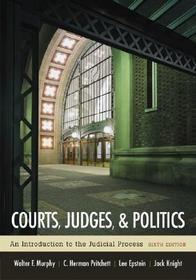
Courts, Judges, and Politics
Series: B&B POLITICAL SCIENCE;
- Publisher's listprice GBP 132.99
-
60 044 Ft (57 185 Ft + 5% VAT)
The price is estimated because at the time of ordering we do not know what conversion rates will apply to HUF / product currency when the book arrives. In case HUF is weaker, the price increases slightly, in case HUF is stronger, the price goes lower slightly.
- Discount 10% (cc. 6 004 Ft off)
- Discounted price 54 040 Ft (51 467 Ft + 5% VAT)
Subcribe now and take benefit of a favourable price.
Subscribe
60 044 Ft

Availability
Uncertain availability. Please turn to our customer service.
Why don't you give exact delivery time?
Delivery time is estimated on our previous experiences. We give estimations only, because we order from outside Hungary, and the delivery time mainly depends on how quickly the publisher supplies the book. Faster or slower deliveries both happen, but we do our best to supply as quickly as possible.
Product details:
- Edition number 6
- Publisher McGraw-Hill Education
- Date of Publication 1 May 2005
- ISBN 9780072977059
- Binding Paperback
- No. of pages816 pages
- Size 231x162x27 mm
- Weight 1027 g
- Language English 0
Categories
Long description:
This classic reader has been a best selling component of the Judicial Process/Judicial Politics/American Legal System course for years. The sixth edition has been thoroughly updated while retaining the features that made it attractive for so long: its effective structure, thorough coverage, narrative voice, choice of excerpts, and teaching flexibility.
This classic reader has been a best selling component of the Judicial Process/Judicial Politics/American Legal System course for years. The sixth edition has been thoroughly updated while retaining the features that made it attractive for so long: its effective structure, thorough coverage, narrative voice, choice of excerpts, and teaching flexibility.
Table of Contents:
Part I "The Nature" of Judging
Chapter 1 Political Jurisprudence
Civil and Common Law Systems
Conceptualization of Law: School of Jurisprudence
*The Institutionalization of Declaratory Theory
*Emerging Challenges: Sociological Jurisprudence and Legal Realism
*Contemporary Scholarship: The Debate Continues
What Is to Come
Readings:
1.1 Sir William Blackstone, Commentaries on the Laws of England
1.2 Alexander Hamilton, The Fedaralist, No. 781.3 Alexis de Tocqueville, Judicial Power in the United States
1.4 Oliver Wendell Holmes, Jr., The Path of the Law
1.5 Banjamin N. Cardozo, The Nature of the Judicial Process
*1.6 Mary E. Becker, Obscuirng the Struggle: Sex Dsicrimination, Social Security, and Stone, Seidman, Sunstein, and Tushnet's Constituional Law
Chapter 2 Courts in Constitutional Democracies
The Origins of Courts
The Roles of Courts
The Expansion of Judicial Power?
Selected References
Readings:
2.1 Lynn Mather, The Fired Football Coach (Or, How Trial Courts Make Policy)
2.2 Marbury v. Madison (1803)
2.3 Eakin v. Raub (1825)
2.4 Robert A. Dahl, Decision Making in a Democracy: The Supreme Court as a National Policy Maker
2.5 D. Casper, The Supreme Court and National Policy Making
Part II The American Legal System
Chapter 3 Judicial Organization
Establishing the U.S. Legal System
Today's System of Federal Courts
State Courts
A New Judicial Federalism
Selected References
Readings:
3.1 Judiciary CAct of 1789, section 25
*3.2 Jonathan Matthew Lohen, Inside Appellate Courts
3.3 C.K. Rowland and Robert Carp, Politics and Judgement of the Federal District Courts
3.4 Charles E. Wyzanski, Jr., The Importance of the Trial Judge
3.5 J. Woodford Howard, Jr., Litigation Flow in Three United Stated Courts of Appeals
3.6 Victor Williams, Solutions to Federal Judicial Gridlock, and John O. Newman, 1,000 Judges--The Limit for an Effective Federal Judiciary
3.7 Robert A. Kagan, Bliss Cartwright, Lawrence M. Friedmna, and Stanton Wheeler, The Evolution of State Supreme Courts
3.8 William J. Brennan, Guardians of our Liberties--State Courts No Less Than Federal
*3.9 Goodrich v. Department of Public Health
Chapter 4 Judicial Selection and Retention
Selection of Federal Judges
Judicial Selection in the States
Disciplining Judges
Selected References
Readings:
4.1 Sheldon Goldman, Ellieot Slotnick, Gerard Gryski, Gary Zuk, and Sara Schiavoni, The Composition of the Federal Judiciary
4.2 Sheldon Goldman, Picking Federal Judges
*4.3 Neil Lewis, Partisanship and the Appointment of Federal Judges (With a Postscript on the George W. Bush Administration)
4.4 Jason M. Roberts, Parties, Presidents, and Procedures
4.5 Gregory A. Caldeira and John R. Wright, Lobbying for Justice
*4.6 Jeffrey A. Segal, Richard J. Timpone, Robert M. Howard, Buyer Beware? Presidential Success Through Supreme Court Appointments
4.7 Thomas G. Walker and Deborah J. Barrow, The Diversification of the Federal Bench: Policy and Process Ramifications
4.8 Thurgood Marshall, Comments on the Missouri Plan
4.9 John T. Wold and John H. Culver, The Defeat of the California Justices
Chapter 5 The Bar
Becoming An Attorney
The Lawyer's Work
Challenges Confronting the Legal Profession
Selected References
Readings:
5.1 Scott Turow, One L: An Inside Account of Life in the First Year at Harvard Law School
5.2 Austin Sarat and William L.F. Felstiner, Law and Strategy in the Divorce Lawyer's Office
5.3 Abraham S. Blumberg, The Practice of Law as a Confidence Game
5.4 F. Lee Bailey, The Defense Never Rests
5.5 Sandra Day O'Connor, Professionalism,
Part III Judicial Power
Chapter 6 Access to Judicial Power
Formal Barriers to Entry in the American Legal System
Informal Barriers to Entry
Accessing the Legal System: Who Uses the Courts?
Selected References
Readings:
6.1 The Washington Administration's Request for an Advisory Opinion and the Justice's Response
6.2 Roe v. Wade (1973) Versus DeFunis v. Odegaard (1974)
6.3 Baker v. Carr (1962)
6.4 Marc Galanter, Why the "Haves" Come Out Ahead: Speculations on the Limits of Social Change
6.5 Clement E. Vose, Litigation as a Form of PRessure Group Activity
6.6 Gregory A. Caldeira and John R. Wright, Organized Interests and Agenda Setting in the U.S. Supreme Court
Chapter 7 Instruments of Judicial Power
Writs of Certiorari
Decisions, Opinions, and Orders
The Injunction
The Contempt Power
The Writ of Habeas Corpus
Selected References
Readings:
7.1 Texas v. Hopwood (1996)
7.2 Madsen v. Women's Health Center, Inc. (1994)
7.3 Wyatt v. Stickney (1971) and Wyatt v. Stickney (1972)
7.4 Illinois v. Allen (1970)
Chapter 8 Limitations on Judicial Power
Internal Checks
Institutional Checks
Checks Imposed by the American System of Separated Institutions
Checks From the States
Checks From the People
Selected References
Readings:
8.1 Wbster v. Reproductive Health Services (1989)
8.2 Lee Epstein and Jack Knight, The Choices Justices Make
8.3 Jeffrey A. Segal, Donald R. Songer, and Charles M. Cameron, Decision Making on the U.S. Courts of Appeals
8.4 Andrew Jackson's Veto of the Bank Bill
8.5 Abraham Lincoln's First Inaugural Address, March 4, 1861
8.6 Franklin D. Roosevelt, Reorganizing the Federal Judiciary
*8.7 George W. Bush's Statement on Same-Sex Marriages (2004)
*8.8 Ex parte McCardle (1869)
8.9 James H. Kuklinksi and John E. Stanga, Political Participation and Government Responsiveness: The Behavior of California Superior Courts
8.10 James L. Gibson, Gregory A. Caldeira, and Vanessa Baird, On the Legitimacy of National High Courts
Part IV Judicial Decision Making
Chapter 9 Fact Finding in the Courts
The Adversarial Process
Juries
Selected References
Readings:
9.1 Marvin E. Frankel, The Adversary Judge: The Experience of the Trial Judge
9.2 Hans Zeisel and Harry Kalven, Jr., The American Experiment
9.3 Geoffrey Norman, Juror Furor
9.4 Darrow, How to Pick a Jury
9.5 Amitai Etzioni, Science: Threatening the Jury Trial9.6 Michael Saks, The Limits of Scientific Jury Selection
9.7 Paul Butler, Black Jurors: Right to Acquit?
9.8 Tracey Gilstrap Weiss, The Great Democratizing Principle: The Effect on South Africa of Planning a Democracy Wihtout a Jury System
9.9 McCleskey v. Kemp (1987)9.10 David C. Baldus, The Death Penalty Dialogue Between Law and Social Science
9.11 John C. Jeffries, Jr., Lewis F. Powell, Jr.
Chapter 10 Precedents and Legal Reasoning
Reasoning by Example
Ration Decidendi Versus Dicta
Treatment of Precedent
Precedents and Decision Making
Selected References
Readings:
10.1 Edward H. Levi, An Introduction to Legal Reasoning
10.2 Lief H. Carter, Reason in Law
10.3 MacPherson v. Buick Motor Co. (1916)
10.4 Briefs Filed in U.S. Term Limits v. Thornton (1995)
10.5 Planned Parenthood of Southeastern Pennsylvania v. Casey (1992)
10.6 Jeffrey A. Segal and Harold J. Spaeth, The Influence of Stare Decisis on the Votes of United States Supreme Court Justices, versus Jack Knight and Lee Epstein, The Norm of State Decisis
10.7 Lewis F. Powell, Jr., Stare Decisis and Judicial Restraint
10.8 Ronald Kahn, Institutional Norms and Supreme Court Decision Making: The Rehnquist Court on Privacy and Religion
Chapter 11 Statutory Interpretation
Plain Meaning and the Problem of Ambiguity
Dealing with Ambiguity: Theories of Statutory Interpretation
Practical Matters in Statutory Interpretation
Statutory Law and Judicial Law Making
Selected References
Readings:
11.1 Felix Frankfurter, Some Reflections on the Reading of Statutes
11.2 Smith v. Unites States (1993)
11.3 United Steelworkers v. Weber (1979)
11.4 Richard A. Posner, The Federal Courts
11.5 Henry M. Hart, Jr., and Albert M. Sachs, The Legal Process
11.6 Conroy v. Aniskoff (1993)
11.7 Frank Easterbrook, Statutes' Domains
11.8 William N. Eskridge, Jr., Dynamic Statutory Interpretation
Chapter 12 Constitutional Interpretation
Constitutional Texts, Constitutions, and Constitutionalism
What Is to be Interpreted
Who Shall Interpret?
How Should Judges Interpret the Constitution? Interpretive Style in the United States
Modes of Interpretation
Constitutional Interpretation as a Form of Statecraft
Selected References
Readings:
12.1 United States v. Nixon (1974)
12.2 Anotnin Scalia, Orginalism: The Lesser Eye
12.3 Robert H. Bork, The Tempting of America
12.4 Thurgood Marshall, Relfections on the Bicentennial of the United States Constitution
12.5 The State v. Makwanyane (1995)
12.6 United States v. Leon (1984)
12.7 Laurence H. Tribe v. Frank H. Easterbrook, Economic Reasoning and Constitutional Interpretation
12.8 William Rehnquist, The Notion of a Living Constitution
12.9 Ronald Dworkin, Taking Rights Seriously
Chapter 13 The Proce
sses of Judicial Decision Making
Trial Courts
Intermediate Appellate Courts
State Supreme Courts
The U.S. Supreme Court
Selected References
Readings:
13.1 Charles Nesson and Associates, Critical Issues in the Courtroom: Exploring a Hypothetical Case
13.2 James Eisentstein and Herbert Jacob, Felony Justice
13.3 Frank B. Cross and Emerson H. Tiller, Judicial Partisanship and Obediance to Legal Doctrine: Whistleblowing on the Federal Courts of Appeals
13.4 Melinda Gann Hall, Constituent Influence in State Supreme Courts
13.5 H.W. Perry, Deciding to Decide
13.6 David J. Danelski, The Influece of the Chief Justice in the Decisional Process
13.7 Paul J. Wahlbeck, James F. spriggs, and Forrest Maltzman, Marshalling the Court: Bargaining and Accomodation on the United States Supreme Court
Chapter 14 The Impact of Judicial Decisions
Compliance and Impact
Anticipated Consequences
Actual Consequences
Explaining and Assessing Effects
Selected References
Readings:
14.1 Bradley C. Canon and Charles A. Johnson, Judicial Policies: Implementation and Impact
14.2 Elliot E. Slotnick and Jennifer A. Segal, Television News and the Supreme Court: All the News That's Fit to Air?
14.3 baker v. Carr (1962)
14.4 Louis Fisher, Legislative Vetoes, Phoneix Style
14.5 Gerald N. Rosenberg, The Hollow Hope: Can Courts Generate Social Change?
14.6 Michael McCann, Reform Litigation on Trial: Review of The Hollow Hope
14.7 Valeria J. Hoekstra, Public Reaction to Supreme Court Decisions
* marks a new addition to this edition
More
9.6 Michael Saks, The Limits of Scientific Jury Selection
9.7 Paul Butler, Black Jurors: Right to Acquit?
9.8 Tracey Gilstrap Weiss, The Great Democratizing Principle: The Effect on South Africa of Planning a Democracy Wihtout a Jury System
9.9 McCleskey v. Kemp (1987)9.10 David C. Baldus, The Death Penalty Dialogue Between Law and Social Science
9.11 John C. Jeffries, Jr., Lewis F. Powell, Jr.
Chapter 10 Precedents and Legal Reasoning
Reasoning by Example
Ration Decidendi Versus Dicta
Treatment of Precedent
Precedents and Decision Making
Selected References
Readings:
10.1 Edward H. Levi, An Introduction to Legal Reasoning
10.2 Lief H. Carter, Reason in Law
10.3 MacPherson v. Buick Motor Co. (1916)
10.4 Briefs Filed in U.S. Term Limits v. Thornton (1995)
10.5 Planned Parenthood of Southeastern Pennsylvania v. Casey (1992)
10.6 Jeffrey A. Segal and Harold J. Spaeth, The Influence of Stare Decisis on the Votes of United States Supreme Court Justices, versus Jack Knight and Lee Epstein, The Norm of State Decisis
10.7 Lewis F. Powell, Jr., Stare Decisis and Judicial Restraint
10.8 Ronald Kahn, Institutional Norms and Supreme Court Decision Making: The Rehnquist Court on Privacy and Religion
Chapter 11 Statutory Interpretation
Plain Meaning and the Problem of Ambiguity
Dealing with Ambiguity: Theories of Statutory Interpretation
Practical Matters in Statutory Interpretation
Statutory Law and Judicial Law Making
Selected References
Readings:
11.1 Felix Frankfurter, Some Reflections on the Reading of Statutes
11.2 Smith v. Unites States (1993)
11.3 United Steelworkers v. Weber (1979)
11.4 Richard A. Posner, The Federal Courts
11.5 Henry M. Hart, Jr., and Albert M. Sachs, The Legal Process
11.6 Conroy v. Aniskoff (1993)
11.7 Frank Easterbrook, Statutes' Domains
11.8 William N. Eskridge, Jr., Dynamic Statutory Interpretation
Chapter 12 Constitutional Interpretation
Constitutional Texts, Constitutions, and Constitutionalism
What Is to be Interpreted
Who Shall Interpret?
How Should Judges Interpret the Constitution? Interpretive Style in the United States
Modes of Interpretation
Constitutional Interpretation as a Form of Statecraft
Selected References
Readings:
12.1 United States v. Nixon (1974)
12.2 Anotnin Scalia, Orginalism: The Lesser Eye
12.3 Robert H. Bork, The Tempting of America
12.4 Thurgood Marshall, Relfections on the Bicentennial of the United States Constitution
12.5 The State v. Makwanyane (1995)
12.6 United States v. Leon (1984)
12.7 Laurence H. Tribe v. Frank H. Easterbrook, Economic Reasoning and Constitutional Interpretation
12.8 William Rehnquist, The Notion of a Living Constitution
12.9 Ronald Dworkin, Taking Rights Seriously
Chapter 13 The Proce
sses of Judicial Decision Making
Trial Courts
Intermediate Appellate Courts
State Supreme Courts
The U.S. Supreme Court
Selected References
Readings:
13.1 Charles Nesson and Associates, Critical Issues in the Courtroom: Exploring a Hypothetical Case
13.2 James Eisentstein and Herbert Jacob, Felony Justice
13.3 Frank B. Cross and Emerson H. Tiller, Judicial Partisanship and Obediance to Legal Doctrine: Whistleblowing on the Federal Courts of Appeals
13.4 Melinda Gann Hall, Constituent Influence in State Supreme Courts
13.5 H.W. Perry, Deciding to Decide
13.6 David J. Danelski, The Influece of the Chief Justice in the Decisional Process
13.7 Paul J. Wahlbeck, James F. spriggs, and Forrest Maltzman, Marshalling the Court: Bargaining and Accomodation on the United States Supreme Court
Chapter 14 The Impact of Judicial Decisions
Compliance and Impact
Anticipated Consequences
Actual Consequences
Explaining and Assessing Effects
Selected References
Readings:
14.1 Bradley C. Canon and Charles A. Johnson, Judicial Policies: Implementation and Impact
14.2 Elliot E. Slotnick and Jennifer A. Segal, Television News and the Supreme Court: All the News That's Fit to Air?
14.3 baker v. Carr (1962)
14.4 Louis Fisher, Legislative Vetoes, Phoneix Style
14.5 Gerald N. Rosenberg, The Hollow Hope: Can Courts Generate Social Change?
14.6 Michael McCann, Reform Litigation on Trial: Review of The Hollow Hope
14.7 Valeria J. Hoekstra, Public Reaction to Supreme Court Decisions
* marks a new addition to this edition
More
sses of Judicial Decision Making

