

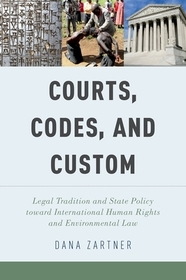
Courts, Codes, and Custom
Legal Tradition and State Policy toward International Human Rights and Environmental Law
- Publisher's listprice GBP 87.00
-
39 280 Ft (37 410 Ft + 5% VAT)
The price is estimated because at the time of ordering we do not know what conversion rates will apply to HUF / product currency when the book arrives. In case HUF is weaker, the price increases slightly, in case HUF is stronger, the price goes lower slightly.
- Discount 10% (cc. 3 928 Ft off)
- Discounted price 35 352 Ft (33 669 Ft + 5% VAT)
Subcribe now and take benefit of a favourable price.
Subscribe
39 280 Ft

Availability
printed on demand
Why don't you give exact delivery time?
Delivery time is estimated on our previous experiences. We give estimations only, because we order from outside Hungary, and the delivery time mainly depends on how quickly the publisher supplies the book. Faster or slower deliveries both happen, but we do our best to supply as quickly as possible.
Product details:
- Publisher OUP USA
- Date of Publication 29 May 2014
- ISBN 9780199362103
- Binding Hardback
- No. of pages352 pages
- Size 163x239x33 mm
- Weight 590 g
- Language English 0
Categories
Short description:
This book explores the role of legal tradition in shaping state policy toward international human rights and environmental law. Examining the institutional and cultural characteristics within a state's legal tradition across ten case studies, the book shows the importance of domestic legal factors to understanding state policy toward international law.
MoreLong description:
Courts, Codes, and Custom addresses the question of why some states recognize and comply with international human rights and environmental law, while others do not. To address this question, Dana Zartner has developed a novel cultural-institutional theory to explain the manner in which a state's domestic legal tradition shapes policy through the process of internalization. A state's legal tradition--the cultural and institutional factors that shape attitudes about the law, appropriate standards of behavior, and the legal process--is the key mechanism by which international law becomes recognized, accepted, and internalized in the domestic legal framework. Legal tradition shapes not only perceptions about law, but also provides the lens through which policy-makers view state interests, directly and indirectly influencing state policy.
The book disaggregates the concept of legal tradition and examines how the individual cultural and institutional characteristics present within a state's domestic legal tradition facilitate or hinder the internalization of international law and, subsequently, shape state policy. In turn it explains both the differences in international law recognition across legal traditions, as well as the variance among states within legal traditions. To test this theory Zartner compares case studies within five of the main legal traditions in the world today: common law (U.S. and Australia), civil law (Germany and Turkey), Islamic law (Egypt and Saudi Arabia), mixed traditions (India and Kenya), and East Asian law (China and Japan). She addresses the differences among legal traditions as well as between states within the same tradition; the important role that legal culture and history play in shaping contemporary attitudes about law; and similarities and differences in state policy towards human rights law versus environmental law.
Table of Contents:
Acknowledgements
Chapter One: Introduction
Chapter 2: Constructing the Cornerstone: The Role of Legal Tradition in Shaping State Policy Toward International Law
Chapter 3: The Common Law: Legal Culture, Courts, and the Continuity of Policy in the United States and Australia
Chapter 4: The Civil Law: History and Nationalism in Germany and Turkey
Chapter 5: Religious Legal Traditions: The Role of Islam in Shaping Policy in Egypt and Saudi Arabia
Chapter 6: Mixed Legal Traditions: The Impact of Custom and Colonialism in India and Kenya
Chapter 7: East Asian Legal Tradition: Confucius, Communism, and Community in China and Japan
Chapter 8: Conclusion
Notes
Bibliography
Index

