

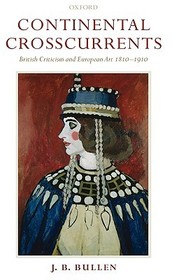
Continental Crosscurrents
British Criticism and European Art 1810-1910
- Publisher's listprice GBP 23.49
-
10 605 Ft (10 100 Ft + 5% VAT)
The price is estimated because at the time of ordering we do not know what conversion rates will apply to HUF / product currency when the book arrives. In case HUF is weaker, the price increases slightly, in case HUF is stronger, the price goes lower slightly.
- Discount 10% (cc. 1 061 Ft off)
- Discounted price 9 545 Ft (9 090 Ft + 5% VAT)
Subcribe now and take benefit of a favourable price.
Subscribe
10 605 Ft

Availability
printed on demand
Why don't you give exact delivery time?
Delivery time is estimated on our previous experiences. We give estimations only, because we order from outside Hungary, and the delivery time mainly depends on how quickly the publisher supplies the book. Faster or slower deliveries both happen, but we do our best to supply as quickly as possible.
Product details:
- Publisher OUP Oxford
- Date of Publication 25 August 2005
- ISBN 9780198186915
- Binding Hardback
- No. of pages308 pages
- Size 233x144x22 mm
- Weight 564 g
- Language English
- Illustrations numerous halftones 0
Categories
Short description:
Continental Crosscurrents explores British attitudes to continental art during the nineteenth and early twentieth centuries and reveals some exciting connections. Coleridge's wild enthusiasm for medieval art and Browning's distaste for Nazarene painting are explored more extensively than ever before. The figures of Edmund Sharpe and Sara Losh in the history of the Romanesque revival are virtually unknown, and for the first time the motives for Alfred Waterhouse's choice of this style for the Natural History Museum in London are revealed. The book concludes with the explosive British reaction to the primitivism of Gauguin and the mysterious unravelling of the identity of the figure of Loerke from Lawrence's Women in Love.
MoreLong description:
Continental Crosscurrents is a series of case studies reflecting British attitudes to continental art during the nineteenth and the early twentieth centuries. It stresses the way in which the British went to the continent in their search for origins or their pursuit of sources of purity and originality. This cult of the primitive took many forms; it involved a reassessment of medieval German and Italian art and offered new ways of interpreting Venetian painting; it opened up new readings of architectural history and the 'discovery' of the Romanesque; it generated a debate about the value of returning to religious subjects in art and it raised the question of the relationship between modern art and Byzantine art in the early twentieth century.
J. B. Bullen's original study presents some exciting findings. Few critics have noticed how much in advance of his time was Coleridge's passion for medieval art; Ruskin's debt in the Stones of Venice to Victor Hugo's Notre Dame de Paris has hardly been noted, and Browning's involvement with the debate on the morality of Christian art is explored more extensively than previously. Three chapters are devoted to the role of British criticism in identifying the Romanesque style in architecture and differentiating it from the Gothic. They trace the concept as it arose in criticism at the beginning of the nineteenth century; its employment in the remarkable buildings of Edmund Sharpe and Sara Losh and the way in which it reached a climax in Waterhouse's enigmatic choice of Romanesque for the Natural History Museum in London. The collection concludes with two continental episodes from the history of modernism. One is the explosive British reaction to the primitivism of Gauguin; the other involves the identifying of one of the characters in D. H. Lawrence's novel Women in Love. Curious evidence suggests that the malevolent figure of Loerke was based on a German sculptor whom Lawrence met in Italy before the First World War.
...a highly readable book replete with fascinating stories ... a scholarly revival of a moment, by which many doors are opened.
Table of Contents:
Introduction
The English Romantics and Early Italian Art
The Romanesque Revival in Britain 1800-1840: 1
The Romanesque Revival in Britain 1800-1840: 2
Robert Browning's 'Pictor Ignotus' and Continental 'Christian' Art
Whoring after Colour: Venetian Painting in England
Ruskin's Venice and Victor Hugo's Paris
Alfred Waterhouse's German Romanesque 'Temple of Nature': The Natural History Museum
The Last Degradation of Art: Gauguin, the British, and French Polynesia
Byzantinism and British Modernism
D.H. Lawrence, German Sculpture, and Women in Love

