

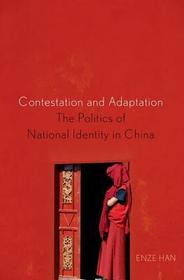
Contestation and Adaptation
The Politics of National Identity in China
- Publisher's listprice GBP 38.99
-
17 603 Ft (16 765 Ft + 5% VAT)
The price is estimated because at the time of ordering we do not know what conversion rates will apply to HUF / product currency when the book arrives. In case HUF is weaker, the price increases slightly, in case HUF is stronger, the price goes lower slightly.
- Discount 10% (cc. 1 760 Ft off)
- Discounted price 15 843 Ft (15 089 Ft + 5% VAT)
Subcribe now and take benefit of a favourable price.
Subscribe
17 603 Ft

Availability
printed on demand
Why don't you give exact delivery time?
Delivery time is estimated on our previous experiences. We give estimations only, because we order from outside Hungary, and the delivery time mainly depends on how quickly the publisher supplies the book. Faster or slower deliveries both happen, but we do our best to supply as quickly as possible.
Product details:
- Publisher OUP USA
- Date of Publication 1 September 2016
- ISBN 9780190624019
- Binding Paperback
- No. of pages240 pages
- Size 155x231x10 mm
- Weight 363 g
- Language English 0
Categories
Short description:
This book compares five major ethnic groups in China and how they negotiate their national identities with the Chinese nation-state: Uyghurs, Chinese Koreans, Dai, Mongols, and Tibetans. By studying their diverse pattern of national identity construction, it sheds light on the nation-building processes in China during the past six decades.
MoreLong description:
Contestation and Adaptation unravels the complexities of national-identity contestation among various ethnic minority groups in China. It focuses on the interactions between domestic and international forces that inform ethnic groups' national-identity contestation, positing a theoretical framework where international factors play a significant role in determining why and when ethnic groups will contest the national identities imposed on them by central governments as part of the nation-building process.
Simmering grievances and occasional outbursts of social unrest among ethnic minority populations in China challenge not only the ruling party's legitimacy and governance, but also contemporary Chinese national identity and the territorial integrity of the Chinese state. But, as Enze Han points out, of the fifty-five ethnic minority groups in China, only the Tibetans and Uyghurs have forcefully contested the idea of a Chinese national identity. He argues that whether ethnic groups contest those national identities depends on whether they perceive a better, achievable alternative. In particular, Han argues that ethnic groups with extensive external kinship networks are most likely to perceive a capacity to achieve better circumstances and are, therefore, more likely to politically mobilize to contest national identity. In the absence of such alternatives ethnic groups are more likely to cope with their situation through emigration, political ambivalence, or assimilation. Using this theoretical framework, the book compares the way that five major ethnic minority groups in China negotiate their national identities with the Chinese nation-state: Uyghurs, Chinese Koreans, Dai, Mongols, and Tibetans.
Overall, Contestation and Adaptation sheds light on the nation-building processes in China over the past six decades and the ways that different groups have resisted or acquiesced in their dealings with the Chinese state and majority Han Chinese society.
Professor Han provides a subtle and learned analysis of ethnic political mobilization and internal conflict in contemporary China. His innovative theoretical approach-combining international and domestic factors-explains why rebellion against Beijing's rule has largely been limited to two of China's many ethnic minorities. This important book will be of great interest to students of comparative politics, international relations, and Asian studies.
Table of Contents:
Acknowledgements
Chapter 1: National Identity Contestation and Adaptation in China
Chapter 2: Politics of Nation-Building in China in Historical Perspective
Chapter 3: National Identity Contestation Among the Uyghurs
Chapter 4: Emigration and Fragmentation of the Chinese Koreans
Chapter 5: Ambiguities of National Identity among the Mongols
Chapter 6: Cultural Revival and National Identity Adaptation among the Dai
Chapter 7: The International Dimension of the Tibet Question
Chapter 8: Conclusion
Notes
Bibliography
Index

