

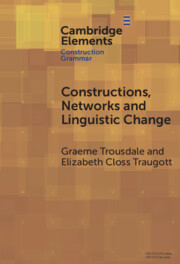
Constructions, Networks and Linguistic Change
Series: Elements in Construction Grammar;
- Publisher's listprice GBP 55.00
-
24 832 Ft (23 650 Ft + 5% VAT)
The price is estimated because at the time of ordering we do not know what conversion rates will apply to HUF / product currency when the book arrives. In case HUF is weaker, the price increases slightly, in case HUF is stronger, the price goes lower slightly.
- Discount 20% (cc. 4 966 Ft off)
- Discounted price 19 866 Ft (18 920 Ft + 5% VAT)
- Discount is valid until: 30 June 2026
Subcribe now and take benefit of a favourable price.
Subscribe
24 832 Ft

Availability
Estimated delivery time: In stock at the publisher, but not at Prospero's office. Delivery time approx. 3-5 weeks.
Not in stock at Prospero.
Why don't you give exact delivery time?
Delivery time is estimated on our previous experiences. We give estimations only, because we order from outside Hungary, and the delivery time mainly depends on how quickly the publisher supplies the book. Faster or slower deliveries both happen, but we do our best to supply as quickly as possible.
Product details:
- Publisher Cambridge University Press
- Date of Publication 21 May 2026
- ISBN 9781009523783
- Binding Hardback
- No. of pages84 pages
- Weight 259 g
- Language English 697
Categories
Short description:
The Element discusses different perspectives on the shape and nature of the language network using evidence from language change.
MoreLong description:
The topic of linguistic networks unites different frameworks in cognitive linguistics. This Element explores two approaches to networks, specifically Construction Grammar of the Goldberg variety and Word Grammar as developed by Hudson, and how they inform work on language change. Both are usage-based theories, but while the basic units of Construction Grammar are conventionalized form-meaning pairings gathered in a construct-i-con, the basic units of Word Grammar are words in dependency and other relations. Construction Grammar allows for schematic, hierarchized abstract generalizations attributable to social groups, whereas Word Grammar focuses on relations at the micro-level and attributable primarily to individuals. Consequences of the differences are discussed with reference to perspectives on the diachronic development of causal connectives in English, especially because.
MoreTable of Contents:
1. Introduction; 2. Overview; 3. A constructional approach to networks; 4. Words, constructions and network structure; 5. Language change and network structure; 6. A case study: the rise of causal connectives in English; 7. Concluding remarks; References.
More
