

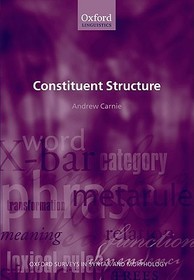
Constituent Structure
Series: Oxford Surveys in Syntax & Morphology; 5;
- Publisher's listprice GBP 28.00
-
12 642 Ft (12 040 Ft + 5% VAT)
The price is estimated because at the time of ordering we do not know what conversion rates will apply to HUF / product currency when the book arrives. In case HUF is weaker, the price increases slightly, in case HUF is stronger, the price goes lower slightly.
- Discount 10% (cc. 1 264 Ft off)
- Discounted price 11 378 Ft (10 836 Ft + 5% VAT)
Subcribe now and take benefit of a favourable price.
Subscribe
12 642 Ft

Availability
Out of print
Why don't you give exact delivery time?
Delivery time is estimated on our previous experiences. We give estimations only, because we order from outside Hungary, and the delivery time mainly depends on how quickly the publisher supplies the book. Faster or slower deliveries both happen, but we do our best to supply as quickly as possible.
Product details:
- Publisher Oxford University Press
- Date of Publication 15 November 2007
- ISBN 9780199262007
- Binding Paperback
- No. of pages312 pages
- Size 245x171x18 mm
- Weight 498 g
- Language English 0
Categories
Short description:
This book explores the empirical and theoretical aspects of constituent structure in natural language syntax, critically examining the strengths and limitations of different approaches. It is an ideal introduction for graduate students and advanced undergraduates and a valuable reference for theoretical linguists of all persuasions.
MoreLong description:
This book explores the empirical and theoretical aspects of constituent structure in natural language syntax. It surveys a wide variety of functionalist and formalist theoretical approaches, from dependency grammars and Relational Grammar to Lexical Functional Grammar, Head-driven Phrase Structure Grammar, and Minimalism. It describes the traditional tests for constituency and the formal means for representing them in phrase structure grammars, extended phrase structure grammars,
X-bar theory, and set theoretic bare phrase structure. In doing so it provides a clear, thorough, and rigorous axiomatic description of the structural properties of constituent trees.
Andrew Carnie considers the central controversies on constituent structure. Is it, for example, a primitive notion or should it be derived from relational or semantic form? Do sentences have a single constituency or multiple constituencies? Does constituency operate on single or multiple dimensions? And what exactly is the categorial content of constituent structure representations? He identifies points of commonality as well as important theoretical differences among the various approaches to
constituency, and critically examines the strengths and limitations of competing frameworks.
This is an ideal introduction for graduate students and advanced undergraduates. It is also a valuable reference for theoretical linguists of all persuasions in departments of linguistics, cognitive science, computational science, and related fields.
...clearly a great resource, with its main strength being the creation of a historical context for current P&P approaches to constituency, and libraries should have a copy.

