

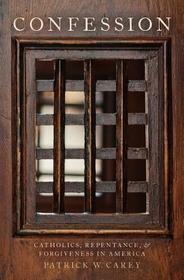
Confession
Catholics, Repentance, and Forgiveness in America
- Publisher's listprice GBP 37.99
-
17 152 Ft (16 335 Ft + 5% VAT)
The price is estimated because at the time of ordering we do not know what conversion rates will apply to HUF / product currency when the book arrives. In case HUF is weaker, the price increases slightly, in case HUF is stronger, the price goes lower slightly.
- Discount 10% (cc. 1 715 Ft off)
- Discounted price 15 437 Ft (14 702 Ft + 5% VAT)
Subcribe now and take benefit of a favourable price.
Subscribe
17 152 Ft

Availability
printed on demand
Why don't you give exact delivery time?
Delivery time is estimated on our previous experiences. We give estimations only, because we order from outside Hungary, and the delivery time mainly depends on how quickly the publisher supplies the book. Faster or slower deliveries both happen, but we do our best to supply as quickly as possible.
Product details:
- Publisher OUP USA
- Date of Publication 29 November 2018
- ISBN 9780190889135
- Binding Hardback
- No. of pages392 pages
- Size 157x236x33 mm
- Weight 658 g
- Language English 0
Categories
Short description:
Confession is a history of penance as a virtue and a sacrament in the United States from about 1634, when Catholicism arrived in Maryland, to 2015, fifty years after the major theological and disciplinary changes initiated by the Second Vatican Council (1962-1965.) In the years since the Council, penitential language has been overshadowed increasingly by the language of conflict and controversy. In today's social and political climate, Confession may help Americans understand how much their society has departed from the penitential language of the earlier American tradition, and consider the advantages and disadvantages of such a departure.
MoreLong description:
Confession is a history of penance as a virtue and a sacrament in the United States from about 1634, when Catholicism arrived in Maryland, to 2015, fifty years after the major theological and disciplinary changes initiated by the Second Vatican Council. Patrick W. Carey argues that the Catholic theology and practice of penance, so much opposed by the inheritors of the Protestant Reformation, kept alive the biblical penitential language in the United States at least until the mid-1960s when Catholic penitential discipline changed.
During the nineteenth and early twentieth centuries, American Catholics created institutions that emphasized, in opposition to Protestant culture, confession to a priest as the normal and almost exclusive means of obtaining forgiveness. Preaching, teaching, catechesis, and parish revival-type missions stressed sacramental confession and the practice became a widespread routine in American Catholic life. After the Second Vatican Council, the practice of sacramental confession declined suddenly. The post-Vatican II history of penance, influenced by the Council's reforms and by changing American moral and cultural values, reveals a major shift in penitential theology; moving from an emphasis on confession to emphasis on reconciliation.
Catholics make up about a quarter of the American population, and thus changes in the practice of penance had an impact on the wider society. In the fifty years since the Council, penitential language has been overshadowed increasingly by the language of conflict and controversy. In today's social and political climate, Confession may help Americans understand how far their society has departed from the penitential language of the earlier American tradition, and consider the advantages and disadvantages of such a departure.
This book challenges scholars to keep investigating how prayer practices—intimate, public, malleable—are built into the broader historical context wherein our interlocutors pray.
Table of Contents:
Acknowledgements
List of Abbreviations
Introduction
PART I: Colonial Era
Chapter One: Trent and Penance in the Colonial Period
PART II: Nineteenth Century
Chapter Two: The Confessional Seal: Legal and Apologetic Dimensions of the Sacrament of Penance
Chapter Three: Sin, Repentance, and Confession in Nineteenth-Century American Protestant Polemics
Chapter Four: American Catholic Theology of Penance in Nineteenth-Century America
Chapter Five: American Catholic Practice of Confession in Nineteenth-Century America
PART III: Twentieth Century
Chapter Six: History, Pius X, and the Practice of Confession, 1900-1920
Chapter Seven: Confession, Continuity, and Reforms, 1920-1960
Chapter Eight: Confession, The New Psychology, and Birth Control, 1920-1960
Chapter Nine: From Confession to Reconciliation, Vatican II to 2015
Conclusion
Bibliography
Index

